
The DOE OICI UAP FOIA trail is a paperwork story, not a crash-retrieval story. Public logs and appeal decisions show what Energy Department intelligence staff were asked to find. They also show where searches stopped.
Three primary sources now anchor that trail. GovernmentAttic posted the DOE Office of Intelligence and Counterintelligence FOIA request log for 2024–2026. The Department’s Office of Hearings and Appeals issued FIA-26-0026 on 16 April 2026. The Black Vault published the redacted Secretary-level package under request HQ-2024-01974-F. Together they map requests, search methods, and releases without requiring belief in any contested recovery claim.
What OICI / DOE-IN Actually Is
DOE brands the office as the Office of Intelligence and Counterintelligence (DOE-IN). Researchers and requesters often shorten the same component as OICI. The office’s public mission statement says it informs national-security decision makers. It aims to mitigate threats to the DOE enterprise and national energy security. It claims unique scientific and technical intelligence and expertise.
That mission explains why UAP FOIA traffic clusters there. Requesters who want “intelligence assessments,” laboratory analysis, or counterintelligence equities naturally name DOE-IN. FOIA routing follows the same logic. When General Counsel assigns a broad Headquarters UAP keyword request, IN is the office most often asked to search first.
IN is not the whole Department. National laboratories, NNSA, the Office of the Secretary, and other components keep separate equities. A search certificate from IN therefore answers a narrower question than “does DOE know anything about UAP.” It answers whether that office located responsive files in the places it searched.
Naming adds one more trap. Official pages and FOIA letters usually say DOE-IN or “Office of Intelligence and Counterintelligence.” Older and informal writing often says OICI. Both labels point at the same Headquarters intelligence component. Accurate citation should follow the document’s own wording and then note the equivalence once.
The DOE-IN FOIA Log as an Inventory
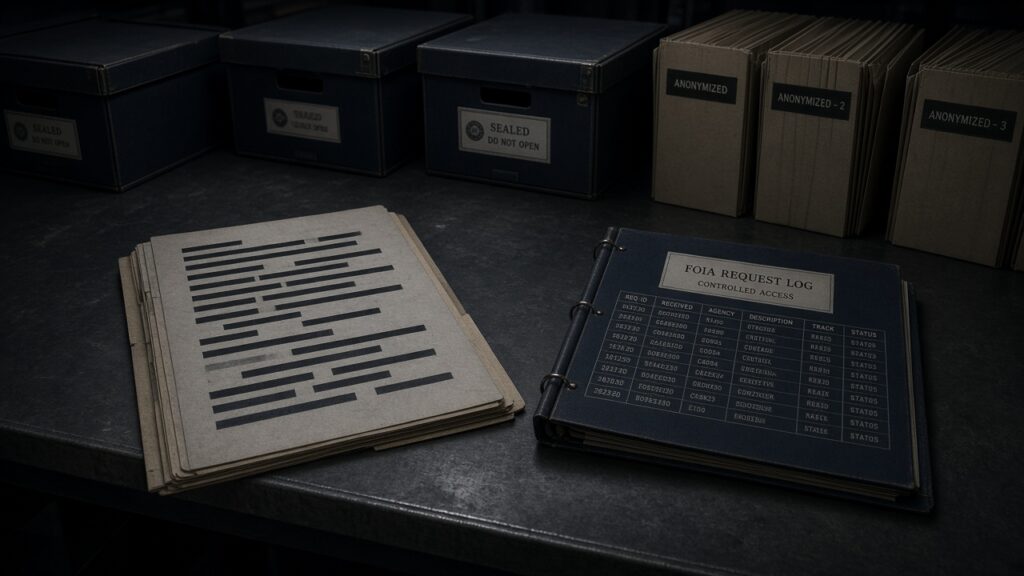
Request HQ-2026-01300-F sought DOE-IN FOIA logs from 1 January 2024 to the date of processing. DOE released the log on 25 March 2026. GovernmentAttic posted the PDF on 6 April 2026. The log’s own footer counts 26 requests. Personal identifiers appear under Exemption 6 redactions.
The log is not a production of UAP assessments. It is a ledger of what people asked IN to find. That distinction matters. A request description can be sweeping while the eventual determination is thin. Reading the ledger first keeps later claims honest.
Several entries expressly target UAP vocabulary. On 5 August 2024, HQ-2024-02832-F asked for DOE-produced intelligence assessments on unidentified anomalous phenomena, unidentified flying objects, unidentified aerial vehicles, and unidentified submerged objects held by DOE-IN. A parallel request, HQ-2025-01049-F, repeated that assessment language on 22 November 2024.
Other UAP-adjacent lines appear without proving results. HQ-2024-00731-F sought MIPRs between OUSDI/AARO and Oak Ridge National Laboratory for 2021–2024. HQ-2026-00230-F asked for program-level details of a legacy UFO/UAP effort that James T. Lacatski said involved DOE. HQ-2026-00290-F sought records of UAP-derived propulsion analysis at DOE and named laboratories from 2000 forward. A Privacy Act-style entry also referenced AARO or ICIG correspondence about a 2022 whistleblower complaint and UAP information from 2019–2025.
None of those log lines equals a released assessment. They document demand. Outcomes require determination letters, Vaughn indexes, or appeal decisions.
What FIA-26-0026 Says IN Searched
OHA Case FIA-26-0026 supplies the clearest public description of an IN UAP keyword search. Kyle Fatigante filed HQ-2026-01441-F on 25 March 2026. The request sought technical reports, briefings, imagery, laboratory analysis, and related records from 1 January 2020 to 25 March 2026. Search terms included UAP, UFO, non-human intelligence, exotic materials, reverse engineering, retrieved craft, and crash retrieval.
DOE’s 31 March 2026 determination letter assigned the Headquarters search to IN. IN reported no responsive records. The letter also stated that a portion fell under NNSA jurisdiction and that NNSA would respond separately. Fatigante appealed the same day. He argued the request was not limited to intelligence-office files and that DOE owed a detailed explanation for skipping other Headquarters offices.
OHA denied the appeal on 16 April 2026. The decision recounts how General Counsel considered Environment, Health, Safety, and Security and the Office of Science. Those offices had recently told GC they lacked UAP equities or jurisdiction. GC therefore referred the Headquarters search solely to IN. An IN employee searched intelligence databases, Outlook inboxes, IN file shares, and IN SharePoint with the requester’s keywords. OHA found that method reasonably calculated to uncover responsive documents. It also found the determination letter adequate. FOIA, the decision stressed, judges search methods rather than harvest size.
The analytical takeaway is procedural. For this request, DOE’s public position is that IN’s named repositories held nothing responsive. That is a verified no-records result for a defined search. It is not a metaphysical claim about every DOE hard drive.
The NNSA carve-out in the same determination letter reinforces that point. Headquarters IN can finish its search while NNSA continues a separate review. Readers who stop at the IN no-records line miss unfinished equity lanes. FIA-26-0026 itself adjudicated only the Headquarters determination under appeal.
Granholm-Era Releases and Heavy Redactions
The Black Vault’s Department of Energy UAP FOIA package under HQ-2024-01974-F sits in a different channel. John Greenewald asked for Secretary Jennifer Granholm emails containing UAP, UFO, AARO, Elizondo, Grusch, and related phrases from 25 February 2021 onward. The Office of the Secretary ran the search. The cut-off date was 4 September 2024. The requester later waived news bulletins and limited “Elizondo” hits to “Luis” Elizondo.
DOE identified two responsive documents and released both in part. The emails, dated 22–23 May 2024, came from Special Assistant Alayna Jenkins. They forwarded “Additional Oversight Hearing Materials” to the Secretary. Attachments included “Odds and Ends for S1 HCOA hearing” and a file titled “UFO and UPA Talking Points.pdf.” Visible talking-point text anticipates questions from Rep. Tim Burchett and possibly Rep. Anna Paulina Luna. It notes the bipartisan UAP/UFO Caucus. It cites the July 2023 House Oversight hearing. It restates DoD’s public line that inquiries had not turned up verifiable information substantiating possession or reverse-engineering of extraterrestrial materials.
Much of the package remains withheld. DOE invoked Exemption 5 for pre-decisional deliberative material, Exemption 6 for personal contact details, and Exemption 4 for proprietary S&P Global subscription content in an LNG attachment. The Black Vault reported an appeal challenging the breadth of the (b)(5) cuts. As of 18 September 2026, researchers should treat that appeal’s final result as pending unless a later OHA decision appears.
The contrast with FIA-26-0026 is instructive. Secretary-level hearing prep can mention UAP while an IN repository search for overlapping keywords returns nothing. Different offices hold different paper. FOIA results track custody and search scope.
What the Paper Trail Does Not Prove
No public document reviewed here confirms a DOE crash-retrieval program, exotic-propulsion lab tasking, or finished IN intelligence assessment on UAP. The FOIA log shows requesters asking for those categories. FIA-26-0026 shows IN reporting none for HQ-2026-01441-F. The Granholm package shows congressional-prep talking points and heavy deliberative redactions.
Absence of released assessments is not proof of concealment by itself. Agencies may hold exempt records, may misroute searches, or may genuinely lack files. OHA’s adequacy standard focuses on reasonableness. Courts can still review later. For now, the verified public record supports a narrower conclusion. Energy-intelligence FOIA traffic is real. Released substance remains thin.
Readers should also avoid collapsing this trail into unrelated controversies. Adjacent Insider Release explainers on other UAP FOIA themes remain separate. This article stays inside DOE-IN logs, OHA FIA-26-0026, and the Granholm Secretary emails.
How to Read Energy-Intelligence FOIA Cleanly
Start with the request number. HQ-2024-01974-F and HQ-2026-01441-F are different instruments. One targeted Secretary email keywords. The other targeted technical and assessment categories and landed in IN. Mixing their outcomes creates false contradictions.
Next, separate log inventory from production. The DOE-IN log proves demand volume and topics. It does not prove what IN produced. Pair each log line with a determination letter before claiming a release.
Then read search certificates and appeal decisions for method. FIA-26-0026 names databases, Outlook, file shares, and SharePoint. That list is the actual search footprint. Claims that “DOE searched everything” overread the record.
Finally, treat Exemption 5 cuts as unresolved until an appeal or court order says otherwise. Deliberative redactions can hide either banal prep notes or sensitive judgments. The visible Granholm talking points already show the public DoD line. Hidden paragraphs remain unknown content, not confirmed secret programs.
Researchers who need a reusable filing pattern can adapt Insider Release’s UAP FOIA request template. Name the office when known. List keyword sets. Ask for search certificates. Those habits match what OHA later inspects.
Statutory archive transfers under NARA’s Record Group 615 remain a separate custody channel from DOE FOIA productions. A FOIA release and a NARA transfer can cover related subjects without being the same legal instrument.
INSIGHT
The DOE OICI UAP FOIA record rewards method over myth. The DOE-IN log shows sustained requester interest in assessments, laboratory tasking, and legacy-program claims. FIA-26-0026 shows IN searching its core repositories with requester keywords and reporting no responsive records for HQ-2026-01441-F. The Granholm HQ-2024-01974-F package shows Secretary-level hearing prep mentioning UAP while withholding most deliberative text.
Those three facts can coexist. Different offices, different request scopes, and different FOIA exemptions produce different public windows. Analytical readers should cite request numbers, search locations, and exemption claims before leaping to program conclusions.
FAQs
What is the DOE OICI UAP FOIA trail?
It is the public set of FOIA requests, logs, and decisions involving DOE’s Office of Intelligence and Counterintelligence and related UAP keyword searches. Core sources include the 2024–2026 DOE-IN FOIA log, OHA Decision FIA-26-0026, and The Black Vault’s HQ-2024-01974-F Granholm email release.
What did DOE-IN search in FIA-26-0026?
For HQ-2026-01441-F, IN searched intelligence-information databases, relevant Outlook inboxes, IN file shares, and IN SharePoint using the requester’s UAP-related keywords. The office found no responsive records. OHA denied the appeal on 16 April 2026. NNSA was to answer separately for its portion.
What did the Granholm-era Department of Energy UAP FOIA release contain?
HQ-2024-01974-F produced two partially released May 2024 emails preparing Secretary Granholm for an oversight hearing. Attachments included “UFO and UPA Talking Points.pdf.” Visible bullets address possible congressional UAP questions and restate DoD’s public no-verifiable-extraterrestrial-materials line. Large sections remain withheld under Exemptions 4, 5, and/or 6.
FAQs on Proof Limits and Source Paths
Does a no-records DOE-IN result prove DOE never touched UAP topics?
No. It proves that a defined IN search of named systems returned nothing responsive for that request. The Granholm Secretary emails show UAP talking points elsewhere in DOE paper. Scope and custody control the outcome.
Where can researchers read the primary documents?
GovernmentAttic hosts the DOE-IN FOIA log PDF. Energy.gov hosts the FIA-26-0026 article page and decision PDF. The Black Vault hosts the HQ-2024-01974-F package. DOE’s intelligence office page states the public mission of DOE-IN.
Takeaways
DOE OICI UAP FOIA coverage should stay inside primary instruments. The DOE-IN log inventories 26 Headquarters intelligence FOIA requests across 2024–early 2026 and includes multiple UAP-themed descriptions. FIA-26-0026 documents an IN keyword search that returned no records and an OHA denial that upheld search adequacy. HQ-2024-01974-F documents two redacted Granholm hearing-prep emails with UAP talking points.
Released substance remains limited. Demand in the log is high relative to public production. That gap is a FOIA fact pattern. It is not, by itself, proof of a hidden DOE retrieval enterprise.
Cite request numbers. Quote search locations. Separate Secretary briefing paper from IN repository certificates.
Call to Action
If you hold a determination letter, search certificate, or OHA filing that closes an open DOE UAP FOIA line cited here, share the primary PDF or .gov link. Prefer energy.gov and GovernmentAttic originals over screenshots. Insider Release will keep mapping Declassified Documents explainers to verifiable request numbers. Corrections grounded in the log, FIA-26-0026, or HQ-2024-01974-F are welcome. Speculation without a citation is not.
Disclaimer: This article was created with the partial or full assistance of artificial intelligence. The text and all accompanying images were generated or significantly supported by AI tools.
Insider Release — Declassified. Analyzed. Explained.