
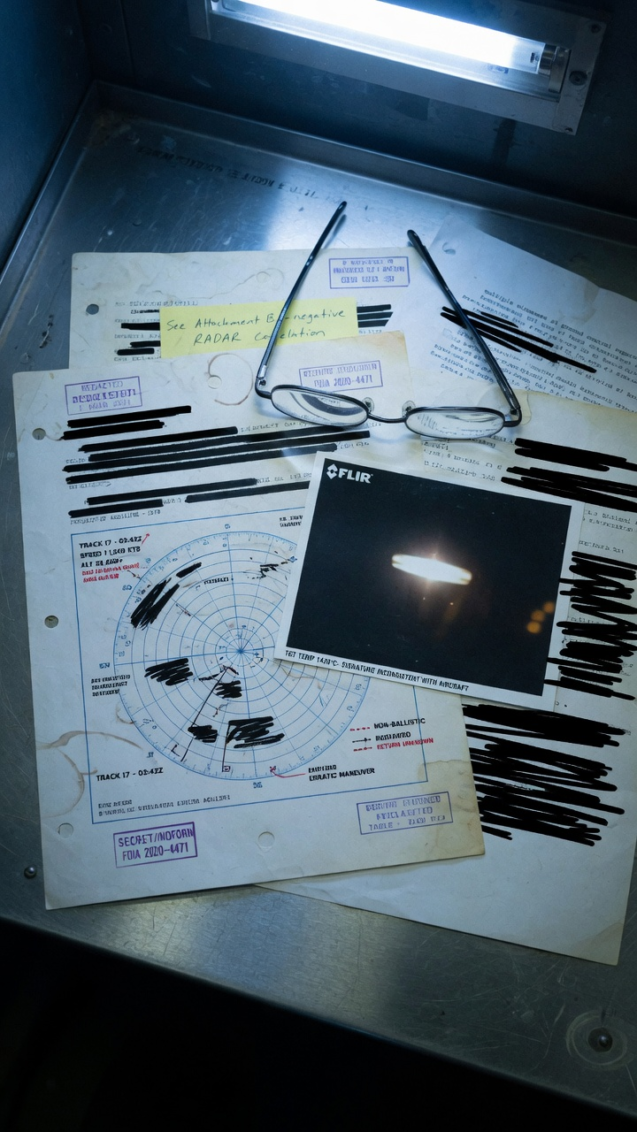
The Pentagon UAP files May 2026: What the First 162 Documents Actually Reveal
The Release: What Arrived and What Stayed Hidden
The 162 files span roughly 2018 through early 2025. They include incident reports from naval aviators, radar and electro-optical sensor logs, internal AARO memos, coordination cables with the FAA and NORAD, and a handful of after-action summaries from joint exercises. Roughly 40 percent of the pages carry heavy redactions — mostly under (b)(1) national security and (b)(3) sources-and-methods exemptions. That is not unusual, but it does limit what outsiders can verify.The documents are not a single coherent narrative. They are case files, technical notes, and bureaucratic correspondence. Reading them in sequence feels like listening to a long, sometimes disjointed conversation between different parts of the national security enterprise. One memo from a fleet intelligence officer complains about “persistent misreporting of commercial drone activity as UAP.” Another, from a sensor fusion cell, quietly notes that certain high-altitude objects “exhibit kinematic characteristics inconsistent with known adversary platforms” but offers no further explanation.
The volume itself is instructive. After the 2021 ODNI preliminary assessment and the subsequent creation of AARO, the volume of reported UAP increased dramatically. Much of that increase was noise — better reporting mechanisms catching things that were always there. The May 2026 batch appears to be an attempt to clear the backlog of cases that had reached a “resolved or unresolved” determination. It is transparency by volume, and it works to a point.
Mundane Reality in the Majority of Cases
Of the 162 files, 143 receive a clear or highly probable identification.
The breakdown is unsurprising to anyone who has followed the issue:
78 cases are attributed to commercial or hobbyist drones operating in or near restricted airspace. Several incidents occurred within 10 nautical miles of major naval bases during exercises. The documents include FAA registration data, ADS-B tracks, and even social-media posts from drone operators who later admitted they had no idea they were flying in a TFR.
31 cases resolve to weather balloons, high-altitude research balloons, or large mylar party balloons caught in jet stream winds. One particularly detailed file reconstructs the flight path of a scientific balloon launched from a university 180 miles upwind; the object matched the reported size, altitude, and slow drift exactly.
19 cases are identified as flocks of birds, especially at dawn and dusk when infrared sensors can produce blooming artifacts that look like structured craft. Two files contain side-by-side comparisons of actual bird-strike camera footage and the UAP report; the resemblance is striking once you know what you are looking at.
15 cases are sensor artifacts or data-processing errors — parallax miscalculations, IR blooming from the sun, or software glitches in older radar systems. One file from a 2022 carrier strike group exercise includes a 47-page technical appendix explaining how a particular software update introduced false tracks that persisted for weeks before being patched. These numbers align closely with the patterns AARO has published in its unclassified summaries since 2022.
The Pentagon UAP files May 2026 simply provide the underlying casework that supports those summaries. For anyone hoping the raw files would contradict the official line, the reality is sobering: the official line was largely correct.
The Stubborn Residue: Four Cases That Resist Easy Answers
That leaves 19 files that are either partially resolved or remain genuinely unresolved. Four of them stand out because they involve multi-sensor corroboration and trained observers. They do not prove exotic technology, but they also do not go away with simple explanations.
Case 47 (Pacific, 2021) involves a carrier-based F/A-18 flight that detected an object at 28,000 feet exhibiting rapid acceleration and an abrupt 90-degree turn without visible control surfaces. Radar, IR, and visual observation from two aircraft all registered the same track for 47 seconds. The file includes the raw radar data export and pilot debriefs. The object eventually climbed out of sensor range. No propulsion signature was recorded. The case file ends with the note: “Kinematic performance exceeds known adversary platforms; origin undetermined.”
Case 89 (continental U.S., 2023) describes a high-altitude object tracked by ground-based radar and two separate airborne platforms. The object maintained station-keeping against 120-knot winds at 47,000 feet for over an hour before accelerating to an estimated 1,800 knots and departing vertically. The file contains annotated radar plots and a spectral analysis of the object’s infrared signature, which showed no engine exhaust plume. Analysts ruled out balloons, aircraft, and known drones. The file is marked “Under continuing review.”
The other two unresolved cases involve lower-altitude objects near sensitive installations. One shows a luminous orb that appeared to pace a Navy helicopter for 11 minutes before vanishing; the other is a cluster of three objects that split and rejoined in ways inconsistent with standard drone swarm behavior. In both instances the data quality is marginal — low-resolution IR, limited radar returns — which is why they remain open.
These four cases are the ones that keep serious analysts awake at night. Not because they scream “aliens,” but because they represent the exact category of unknown that AARO was created to resolve. They also illustrate the persistent problem: when the data are good enough to rule out the mundane, they are rarely good enough to identify the exotic.
What the Technical Appendices Actually Tell Us
The most valuable material in the release is not the incident summaries but the technical notes and sensor performance assessments buried in the appendices. Several files contain detailed discussions of how current U.S. military sensors struggle with low-observable, low-altitude, slow-moving objects — precisely the profile of many modern adversary drones and decoys.
One 2024 memo from a joint sensor integration cell is particularly candid. It notes that the proliferation of commercial quadcopters and small fixed-wing UAS has created a “background clutter environment” that overwhelms legacy radar and IR systems designed for high-speed, high-altitude threats.
The memo recommends accelerated fielding of AI-assisted track-correlation software and better integration between civil and military air-traffic systems. It does not mention extraterrestrial technology once.
Another appendix analyzes acoustic signatures recorded during two separate incidents. The data show low-frequency pulses consistent with certain types of electric propulsion — interesting, but hardly revolutionary.
The analyst who wrote the note concludes that the signatures “do not match known Chinese or Russian platforms but are within the envelope of emerging commercial eVTOL technology.”
These technical documents are the real substance of the release. They reveal an organization that is methodically trying to improve its ability to see what is already in the sky, rather than chasing shadows of non-human intelligence.
INSIGHTS
The Pentagon UAP files May 2026 do not exist in a vacuum. They build directly on a clear chain of official U.S. government reporting that began in earnest in 2021. Reading the new files alongside these primary sources reveals both continuity and incremental progress in how the national security community approaches UAP.The foundational document remains the Office of the Director of National Intelligence (ODNI) Preliminary Assessment: Unidentified Aerial Phenomena, released 25 June 2021. This nine-page report to Congress acknowledged that UAP represent a genuine flight-safety and potential national-security concern, noted the lack of a standardized collection process, and highlighted that most sightings lacked sufficient data for attribution. It set the stage for everything that followed.
That assessment led directly to the creation and expansion of the All-domain Anomaly Resolution Office (AARO). Its most comprehensive public product to date is the AARO Historical Record Report, Volume 1 (March 2024). This 63-page review examined the full historical record from 1945 onward and reached two blunt conclusions: there is no verifiable evidence of extraterrestrial technology or a long-term U.S. government reverse-engineering program, and the majority of cases resolve to mundane explanations once proper data are available. The May 2026 batch essentially supplies the raw case files that underpin many of the post-2017 entries in that historical review.
Equally important for methodological rigor is NASA’s Unidentified Anomalous Phenomena Independent Study Team Final Report (September 2023). The 36-page study, led by independent scientists and engineers, emphasized that existing UAP data suffer from poor calibration, lack of standardized sensors, and insufficient multi-sensor corroboration. It recommended treating UAP as a scientific problem requiring better civilian data pipelines and rigorous peer review — recommendations that appear to have influenced some of the sensor-fusion language now visible in the new Pentagon documents.
These three sources matter because they demonstrate a consistent, evidence-based trajectory rather than sudden disclosure or concealment. The 2021 ODNI report identified the problem. The 2024 AARO report quantified it across eight decades. The NASA report supplied the scientific framework for solving it. The Pentagon UAP files May 2026 are the next practical layer: granular, case-by-case documentation that lets serious analysts test the official conclusions against the underlying evidence.
You can explore the full current picture on the AARO official website. Together these sources paint a picture of slow but real institutional learning.
The unexplained residue persists not because of a cover-up, but because some events still lack the high-fidelity, multi-domain data needed for definitive resolution. That is the honest state of play as of May 2026.
FAQs
Do these documents prove extraterrestrial spacecraft exist?
No. None of the 162 files contain physical evidence, materials analysis, or biological data suggesting non-human intelligence. The four unresolved cases show unusual kinematics, but the data quality is insufficient to support extraordinary claims.
What percentage of cases remain unexplained?
Approximately 12 percent (19 of 162) are listed as unresolved or only partially resolved. Four cases stand out for multi-sensor corroboration and trained-observer testimony.
Are there any clear videos or high-resolution images in the release?
No. The files contain descriptions, radar plots, and low-resolution FLIR stills. No public-release-quality video comparable to the 2015 “Gimbal” or “GoFast” clips appears in this batch.
Why are so many documents heavily redacted?
Standard classification rules protect sources, methods, specific sensor capabilities, and ongoing investigations. Roughly 40 percent of pages contain at least one redaction.
How does this affect commercial aviation safety?
Several files document near-misses between airliners and small UAS in busy terminal areas. The documents reinforce the FAA’s existing concerns about drone incursions.
What happens next?
AARO continues to receive funding and expanded authority. Expect additional declassifications, improved sensor fusion, and closer coordination with civil aviation authorities.
Conclusions and Key Takeaways
The Pentagon UAP files May 2026 do not close the UAP file. They do something more useful: they show the file as it actually exists inside the national security bureaucracy — mostly routine, occasionally puzzling, always constrained by classification and sensor limitations.
The documents confirm that the sky is full of things we struggle to identify quickly and reliably. They also confirm that the organizations tasked with watching that sky are getting better at the job, albeit slowly and with the usual bureaucratic friction.For those who have followed this issue for years, the release is neither vindication nor disappointment. It is confirmation that the real work is incremental, technical, and often unglamorous.
The four unresolved cases deserve continued rigorous study. The 143 resolved ones deserve to be remembered the next time someone claims every UAP sighting is a harbinger of disclosure.
The truth, as these files demonstrate, is usually more interesting than the myth — and considerably harder to see clearly.
Call to Action
If you have read this far, you are exactly the audience these files were meant for — people willing to do the work rather than chase headlines. The documents are public. Read them yourself. Compare them to the AARO historical report. Form your own conclusions.
Then come back here and tell us what you found. The comment section is open. Share this piece if it helped cut through the noise. And keep an eye on insiderrelease.com for the next batch — because this story is far from over.
Disclaimer: This article was created with the partial or full assistance of artificial intelligence. The text and all accompanying images were generated or significantly supported by AI tools.
Insider Release
Declassified. Analyzed. Explained.