
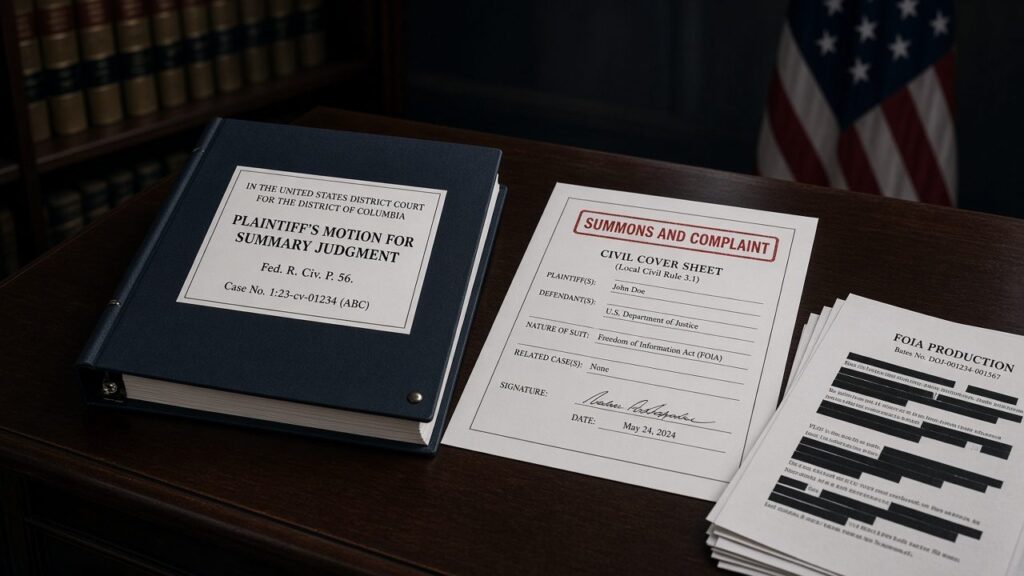
The Grusch DoD FOIA summary judgment fight turns on a narrow question: did the Department of Defense run a legally adequate search? On 21 September 2026, DOJ moved for summary judgment in Grusch v. United States Department of Defense, No. 1:26-cv-00607 (E.D. Va.). Plaintiff’s opposition—and any cross-motion—is due 12 October 2026. A hearing is noticed for 20 November 2026 in Alexandria. The public docket is on CourtListener 72351349.
This case is a FOIA paperwork fight, not a crash-retrieval story. DoD released 40 pages on 18 May 2026. Plaintiff later confirmed he is not challenging those redactions. The sole remaining issue is search adequacy. That bottleneck decides whether more records about unauthorized-disclosure complaints tied to David Charles Grusch—and UAP/UFO terms—must be hunted again.
Grusch DoD FOIA Summary Judgment: What the Fight Is
Summary judgment asks a court to decide a case without trial when the material facts are not genuinely disputed. In FOIA suits, agencies often move for judgment once they claim a reasonable search and proper withholdings. Here the parties already dropped the withholding fight for the May release. The Fourth Joint Status Report (Dkt. 27) says Plaintiff is not challenging redactions or withholdings on that production. The remaining dispute is whether DoD’s search methods were legally adequate.
DOJ’s memorandum (Dkt. 31) frames the issue in one line: all that remains is whether DoD discharged its FOIA duty to conduct a reasonable search. The motion relies on the declaration of Stephanie Burke, Chief of the Freedom of Information Division in DoD’s Office of the General Counsel. Burke describes where DoD searched, which custodians it chose, which terms it used, and what it found.
Courts judge FOIA searches by methods, not harvest size. Fourth Circuit and related doctrine (as briefed) treat agency affidavits as enough when they are detailed and made in good faith. An opposition must raise specific defects—wrong offices, missing custodians, thin terms, or a duty to follow leads—rather than mere disappointment with page count.
From FOIA 25-FP-0002 to the EDVA Docket
Grusch submitted the request on 30 September 2024. DoD received it on 1 October 2024. The OSD/JS FOIA Requester Service Center assigned case number 25-FP-0002. An interim response on 3 October 2024 tasked Oversight & Compliance / Intelligence Oversight Division (IOD). The request sought records from the Senior Intelligence Oversight Official (SIOO) office, including Mark Dupont, for the window 1 April 2023 through 31 December 2023.
IOD’s shared-folder search on 7 October 2024 found no Grusch unauthorized-disclosure hits. Burke’s declaration states that unauthorized disclosures are generally information-security matters, not IOD “questionable intelligence activity†work, and that Oversight & Compliance does not carry responsibility for UAPs or UFOs. DoD still searched the named component. It then searched classified and unclassified email for Dupont and for Joo Chung, then ATSD(PCLT) with leadership over IOD.
Those email searches returned 22 potentially responsive records totaling 6,632 pages. After coordination, DoD released 40 pages on 18 May 2026. The cover letter (DEX 2 / Dkt. 31-2) cites FOIA exemptions (b)(5) and (b)(6) only. No Glomar response appears in the MSJ packet. The May letter does not invoke (b)(1) or (b)(3).
Grusch sued on 2 March 2026 in the Eastern District of Virginia, Alexandria Division, before Judge Leonie M. Brinkema (Magistrate Judge William E. Fitzpatrick). After answer and a processing stay with joint status reports, the parties reached an impasse on search adequacy. Judge Brinkema set a cross-MSJ briefing schedule on 6 August 2026 (Dkt. 28). Defendant filed on 21 September 2026 (Dkts. 30–32).
How DOJ Describes the Search
Burke’s declaration is the factual spine of the motion. It walks through routing to Oversight & Compliance and IOD. It lists search terms drawn from the request: “David Charles Grusch,†“Grusch,†“unidentified aerial phenomenon,†“unidentified anomalous phenomenon,†“UAP,†and “UFO.†Shared folders and both custodians’ email systems were searched with those terms on classified and unclassified networks.
DOJ argues that DoD searched the component Plaintiff named even though that office says it does not normally handle unauthorized-disclosure security matters. It searched Dupont, whom the request named. It added Chung because leadership expected responsive records there. It applied Plaintiff-supplied vocabulary and located potentially responsive volume. Under Rein, Iturralde, and Empower Oversight as briefed, that showing—if credited—meets the reasonableness standard.
The 6,632-to-40 drop is a processing and responsiveness story after the search, not by itself proof of an inadequate hunt. Plaintiff has taken challenges to the May withholdings off the summary-judgment table. An opposition that reopens exemptions would need to say so clearly. As of the September filings, the live paper fight is search architecture.
Readers tracking parallel search-adequacy FOIA trails can compare the DOE OICI UAP FOIA trail, where Energy intelligence search methods—not lore—also controlled the public record.
What the FOIA Request Actually Asked
The request had two prongs over the same April–December 2023 window. First, records related to unauthorized-disclosure complaints to DoD SIOO regarding disclosures concerning David Charles Grusch. Second, unauthorized-disclosure complaint records that also hit UAP/UFO phrases. Burke further quotes a request for related communications, emails, reports, and memoranda about handling or investigation of such complaints.
That language matters for any Oct. 12 opposition. Search-term fights often turn on whether name-plus-UAP strings catch “unauthorized disclosure,†security-incident jargon, or other labels that might appear without UFO keywords. Custodian fights turn on whether Dupont and Chung alone were enough once Burke said IOD is not the usual home for information-security unauthorized-disclosure matters.
The complaint frames the records as relevant to whistleblower-retaliation claims and public interest. Motives attributed in interviews are not court findings about what still-unreleased files contain. This explainer stays inside the docket, the request quotes in the MSJ packet, and the May release letter.
Researchers building their own agency filings can adapt Insider Release’s UAP FOIA request template. Name offices. List keyword sets. Ask for search certificates. Those habits match what courts later inspect when adequacy is disputed.
Calendar: Oct 12, Oct 26, Nov 9, Nov 20
Under Dkt. 28, Defendant’s MSJ was due by 21 September 2026 and was filed that day. Plaintiff’s opposition brief, and any combined cross-motion for summary judgment, is due on or before 12 October 2026. That is the next primary document to watch. It should state specific search defects with cites to Burke, the JSRs, and any deficiency letters summarized on the docket.
If Plaintiff cross-moves, Defendant’s reply and opposition to the cross-motion are due 26 October 2026. Plaintiff’s reply on the cross-motion, if any, is due 9 November 2026. The notice of hearing (Dkt. 32) sets argument for 20 November 2026 at 10:00 a.m. in Alexandria Courtroom 700 before Judge Brinkema. The notice reserves flexibility if Plaintiff skips a cross-motion.
What to watch in the opposition: whether Plaintiff argues a follow-the-lead duty to information-security offices after Burke’s own description; whether more custodians or systems should have been tasked; whether search terms were too narrow for prong one; and whether Burke’s personal knowledge versus reconstructed file review is challenged. Relief if Plaintiff wins is typically more search work and a supplemental declaration—not an automatic dump of thousands of unreleased pages.
What This Case Is Not
This lawsuit is not a Glomar or classification-exemption showdown. The May 18 production letter cites (b)(5) and (b)(6) only. Plaintiff confirmed he is not challenging those redactions on the released set. Inventing Espionage Act litigation theories beyond what the FOIA request and pleadings actually seek overreads the free record.
It is also not the ODNI NDA-waiver channel covered elsewhere on Insider Release. A UAP NDA waiver process is a different legal object from this EDVA FOIA search fight. Corporate-registration controversies about other Grusch-linked entities are likewise outside this docket and should not be collapsed into CourtListener 72351349.
Secondary web pages have already mangled counsel maps and CourtListener ids. Plaintiff counsel on the complaint and Dkt. 27 signatures includes Anthony I. Shin and Basil M. Al-Qaneh of Shin Law Office, PLC, and Huntington M. Willis of Martin & Jones, PLLC (pro hac). Defense counsel of record on the MSJ is AUSA Matthew J. Mezger. The correct CourtListener docket id is 72351349, not the truncated 7235134 lead that points to an unrelated bankruptcy case.
Exact text of Plaintiff’s June and July deficiency letters is not in the free RECAP packet retrieved for this explainer. The Fourth JSR summarizes an impasse on search adequacy. The substance of the 40 released pages is not attached beyond the cover letter. Readers should treat those gaps as open, not as invitations to invent content.
INSIGHT
FOIA disclosure fights often die—or reopen—on search adequacy long before the public ever sees contested pages. Grusch v. DoD now sits at that choke point. DOJ says a named-office search, two custodians, and Plaintiff-supplied UAP/name terms were enough. The May release produced 40 pages under (b)(5) and (b)(6). Plaintiff waived challenges to those cuts for summary judgment and kept the fight on whether DoD looked in the right places.
The Burke declaration’s own description that unauthorized disclosures usually live in information security—not IOD—gives the Oct. 12 opposition a concrete lead to argue. Whether Judge Brinkema treats that lead as fatal to the agency’s reasonableness showing is the live question. Cite docket numbers. Separate search from exemptions. Keep CourtListener 72351349 as the canonical public map.
FAQs
What is the Grusch DoD FOIA summary judgment motion about?
DOJ asks Judge Brinkema to enter judgment for DoD because the agency ran a legally adequate FOIA search in 25-FP-0002 / EDVA 1:26-cv-00607. The sole SJ issue is search adequacy (Dkt. 27–28, 31).
Is Plaintiff challenging the May 18 redactions?
No. The Fourth Joint Status Report says Plaintiff is not challenging redactions or withholdings on the 18 May 2026 release. The live issue is search adequacy.
Which FOIA exemptions appear on the production letter?
The May 18 release letter (DEX 2) cites (b)(5) and (b)(6) only. The MSJ packet does not assert Glomar, (b)(1), or (b)(3) for that letter.
How does search adequacy differ from redaction fights?
Search adequacy asks whether methods were reasonably calculated to find records. Redaction fights ask whether exemptions properly withhold located records. This SJ posture is search only.
Is the ODNI NDA waiver the same lawsuit?
No. An NDA-waiver process for authorized conversations is a separate channel from this EDVA FOIA search fight.
How should readers read a FOIA motion for summary judgment?
Start with the agency declaration: offices, custodians, systems, and terms. Then read what plaintiff says was missed. Check whether exemptions remain contested. Prefer CourtListener and RECAP PDFs.
When is the next filing and hearing?
Opposition (and optional cross-MSJ) is due 12 October 2026. Defendant reply is due 26 October if a cross-motion is filed. Plaintiff’s cross-reply is due 9 November if applicable. Hearing is noticed for 20 November 2026 at 10:00 a.m. in Alexandria.
Takeaways
Grusch v. DoD is an Eastern District of Virginia FOIA case (1:26-cv-00607) keyed to OSD/JS request 25-FP-0002. DOJ moved for summary judgment on 21 September 2026. The fight is search adequacy, not May 18 exemption disputes. DoD describes shared-folder and email searches of Dupont and Chung that tagged 22 records / 6,632 pages and released 40 pages under (b)(5) and (b)(6).
Plaintiff’s Oct. 12 filing will define whether courts must order more searching. Watch custodians, offices, follow-the-lead arguments, and term lists. Use CourtListener docket 72351349. Do not conflate this suit with NDA-waiver paperwork or unrelated corporate stories.
Cite Dkts. 27, 28, 30–32, the Burke declaration, and the May release letter before drawing program conclusions from page counts alone.
Call to Action
If you hold a free primary PDF—Plaintiff’s Oct. 12 opposition, a Vaughn index later filed on ECF, or clearer OCR of complaint exhibits—share the CourtListener or .gov link. Prefer RECAP originals over screenshots. Insider Release will keep mapping Declassified Documents and UAP Disclosure explainers to verified docket numbers. Corrections grounded in Dkts. 27–32 are welcome. Speculation without a citation is not.
Disclaimer: This article was created with the partial or full assistance of artificial intelligence. The text and all accompanying images were generated or significantly supported by AI tools.
Insider Release — Declassified. Analyzed. Explained.
You may also like
Scientists Filed 50+ UAP Declassification Requests — Varginha & Glomar Explained
CIA CREST Database: How to Search the CIA Reading Room
DOE OICI UAP FOIA: What Energy Intelligence Releases (and Withholds)
David Grusch and StarDustX in Alabama: COO Claim vs Filings
CIA Stargate Documents Explained: What’s in the CREST Remote-Viewing Files (and How to Read Them)