
The UAP Science Advisory Council declassification requests story broke into public view again on 22 September 2026. On NewsNation’s Reality Check, astroparticle physicist Matthew Szydagis said council members had already filed more than 50 declassification requests. He named the disputed 1996 Varginha episode in Brazil as the case he most wants disclosed. Mid-October FOIA clocks on related congressional asks will matter as much as the interview sound bite.
This explainer stays FOIA-first. A scientist’s request is not proof of non-human intelligence. A CIA Glomar reply is not proof of a cover-up. Primary dates, letters, and scientist-attributed wording below keep those lines clear. Adjacent Insider Release pieces on the DOE OICI UAP FOIA trail show the same method: track request numbers, not lore.
What the UAP Science Advisory Council declassification requests actually cover
Harvard astrophysicist Avi Loeb chairs the council. In a 19 July 2026 Medium essay — and a matching New York Post opinion piece — he wrote that the council “already submitted a request for more than 50 items of information concerning past incidents and possible related materials.” The Harvard Crimson reported on 11 July 2026 that the council had asked the Pentagon to declassify 50 items. It had not yet received a response.
Szydagis’s NewsNation framing uses plural wording: “more than 50 declassification requests.” Above The Norm’s 24 September 2026 synthesis follows that NewsNation line. The public record therefore shows a wording variance. Loeb describes a request for more than 50 items. Szydagis and NewsNation describe more than 50 declassification requests. No agency has published a matching inventory of those filings. Attribution stays with the scientists until one does.
Nothing in those statements validates any particular UAP event as extraterrestrial. Loeb’s own Medium line is the right guardrail: “Unknown does not mean extraterrestrial, but it also should not be explained away without evidence.” The asks are for documents, timestamps, logistics, and related materials. Outcomes may be conventional, thin, or still withheld for national-security reasons unrelated to exotic craft.
What the Council Is — and Is Not
Formation clustered in June 2026. Loeb has written that an ODNI representative asked him to establish and lead the group. DefenseScoop’s Brandi Vincent confirmed the formation on 17 June 2026. An ODNI official told DefenseScoop that a Governance Board and advisory groups were standing up. Loeb’s 16 June Medium post listed early members and stressed unclassified-only work. His 19 June follow-up reiterated that limit after the first member meeting.
The clearance rule explains why declassification sits at the center of the story. Loeb’s 19 July Medium essay states that the council will process only unclassified information. Methods and conclusions can then be shared publicly. Classified access, he wrote, goes through the UAP Governing Board and relevant agencies that the council advises. The council site at uapsac.com repeats the unclassified-only posture. DefenseScoop reported the same limit.
Public membership lists evolved across June and July. Early Loeb and DefenseScoop names included Carol Cleland, Richard Cloete, Tim Gallaudet, Garry Nolan, Michael Shermer, Matthew Szydagis, and others. The Crimson later described roughly 18 publicly named participants, about a dozen with Harvard ties, unpaid work, and no budget. Roster counts should be dated to the source.
One gap remains important. Above The Norm notes that a standalone federal webpage for the council’s full structure and powers has not been located. The live site is uapsac.com, a Loeb-led council page, not an agency.gov charter. Claims about mandate and the more-than-50 asks should stay attributed to the scientists and to DefenseScoop’s ODNI confirmation unless agencies publish more.
Burlison’s Parallel Track: FBI, CIA, and Glomar F-2023-00442
Rep. Eric Burlison’s Varginha records push runs on a separate track from the council’s scientist asks. On 1 May 2026 he wrote FBI Director Kash Patel. On 7 July 2026 he wrote CIA Director John Ratcliffe. His office announced the paired letters on 8 July 2026. The FBI PDF on house.gov embeds the earlier private CIA FOIA trail.
That private FOIA was postmarked 5 December 2022 and assigned CIA reference F-2023-00442. It sought records for 14–28 January 1996 in Brazil, including Campinas. Topics included U.S. government flights and whether CIA’s Latin America Division or Brasilia Station knew of any material transfer from Brazilian armed forces to the U.S. government.
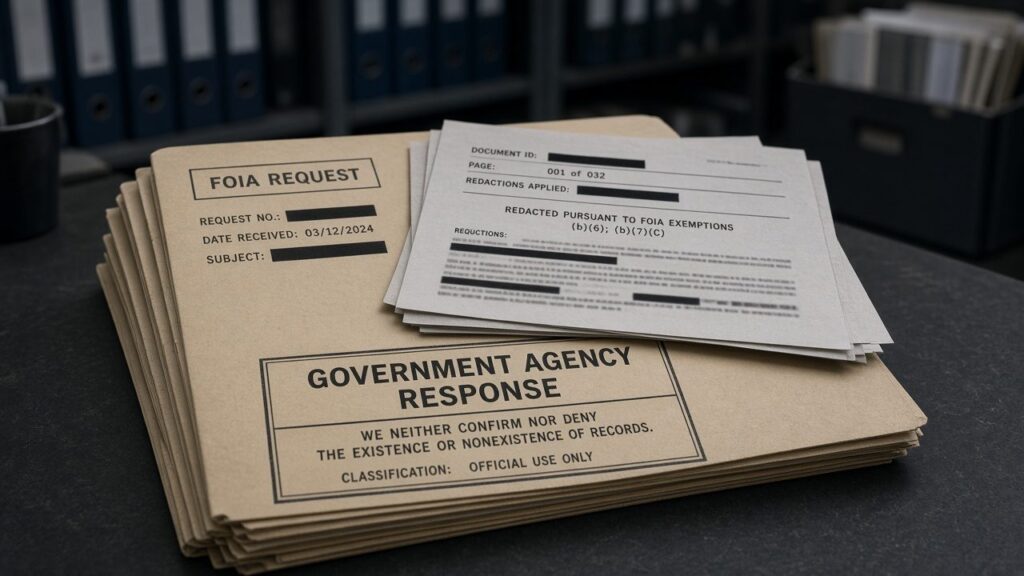
CIA’s final response arrived on 10 January 2025. Under Section 3.6(a) of Executive Order 13526, the agency could neither confirm nor deny the existence or nonexistence of responsive records. That fact was itself classified and protected as intelligence sources and methods. The request was denied under FOIA exemptions (b)(1) and (b)(3).
Burlison’s FBI letter is careful about proof. It does not ask the FBI to validate disputed public claims or prejudge whether any federal law was violated. The CIA letter argues that Congress’s oversight duties are broader than a private FOIA Glomar posture. The letters seek fresh searches, preservation, production within 30 days, and detailed itemization for withholdings.
On Elizabeth Vargas Reports, updated 15 July 2026, Burlison said he had not heard back directly. He also said he will not believe extraordinary claims until he experiences them himself. As of that mid-July interview, no public production package from those letters was on the record.
Varginha 1996: Witness Claims, Official Conclusion, U.S. Paper
Varginha sits in Minas Gerais, Brazil. Popular accounts center on 20 January 1996. Three young women described an unusual biped near the Jardim Andere area. Later lore layered craft sightings, military activity, hospital scenes, alleged capture or transfer, and the death of military police officer Marco Eli Chereze. None of those extraordinary interpretations is established by publicly verified physical evidence. “Roswell of Brazil” is popular branding, not an official finding.
Brazil’s 1997 military inquiry reached a different conclusion. Official reporting summarized in English secondary sources holds that the women likely mistook a local man nicknamed “Mudinho” (Luiz Antônio de Paula). He was described as having a mental disability, dirty and crouching in rain. Army truck and firefighter presence was explained as routine maintenance or misinterpreted logistics. Skeptical reviews such as Brian Dunning’s Skeptoid piece argue nothing unusual occurred.
Scientist and congressional interest targets archives, not ET endorsement. Szydagis naming Varginha as a priority is a records ask. Burlison’s letters seek U.S. flight and liaison equities around January 1996. Campaign-line comments attributed to former Brazilian Defense Minister Aldo Rebelo — release Brazilian files if elected and if the United States releases documents — are conditional political statements. They are not on-record ET confirmation. Claims that Rebelo “confirmed ET” overread the available words.
Keep four layers separate: witness claims; the Brazilian 1997 Mudinho and routine-activity conclusion; the U.S. Glomar and oversight trail; and scientist interest in timestamps and custody documents. Collapsing those layers into “ET confirmed” invents a finding the public record does not support.
FOIA Clocks, Glomar, and Vaughn Indexes
Under 5 U.S.C. § 552(a)(6)(A)(i), an agency generally must decide within 20 days, excluding Saturdays, Sundays, and legal public holidays, whether to comply, and must notify the requester. The clock starts when the appropriate component receives the request. Unusual circumstances can support a further extension, typically up to 10 working days, with written notice. Practice often diverges from the statute. Backlogs are common. Missing a clock is not automatic proof of a cover-up.
Glomar is a specific posture. The agency neither confirms nor denies that responsive records exist when existence or nonexistence itself is protected. The label comes from the Glomar Explorer litigation against the CIA. A sustained Glomar usually means no search description that would confirm holdings and no Vaughn index of withheld pages. In F-2023-00442, exemptions (b)(1) and (b)(3) track classified national-security information and intelligence sources-and-methods statutes.
Vaughn indexes, from Vaughn v. Rosen, itemize withheld records and exemption justifications once existence is acknowledged. They enable adversarial testing of redactions. They are not produced under a successful Glomar. Burlison’s demand for detailed itemization is a congressional analogue aimed past the private-FOIA wall.
Declassification under Executive Order 13526 is related but not identical to FOIA. FOIA is a public right with exemptions. Declassification is an executive classification review path. Readers who want reusable filing habits can use Insider Release’s UAP FOIA request template. When older CIA equities surface in open archives, Insider Release’s guide on how to search CIA CREST / Stargate files shows how released collections differ from a live Glomar.
What to Watch Into Mid-October
Two clocks deserve calendar attention. First, any agency determinations or interim notices tied to the council’s scientist-attributed asks for more than 50 items or declassification requests. Second, replies to Burlison’s May FBI and July CIA letters. Those letters sought production within 30 days and a schedule within 10 business days. Mid-October 2026 is a natural checkpoint for letters, briefings, or further Glomar-style refusals.
Watch the form of any reply. A no-records letter, a partial release with a Vaughn-style index, a classified briefing notice, or another neither-confirm-nor-deny posture each mean different things. Do not collapse them. Watch for any agency inventory that matches Loeb’s “more than 50 items” language. Until that inventory exists, keep the 50-plus figure scientist-attributed.
Trump-era February 2026 directive language on releasing UAP-related government files forms policy backdrop. So does DefenseScoop’s report of file batches on 8 May, 22 May, and 12 June 2026. Neither equals an answer to Varginha FOIA F-2023-00442 or to the council’s item list.
INSIGHT
The September NewsNation segment and the July Loeb essays describe the same structural bind. Scientists on an unclassified advisory track cannot inspect classified holdings, so they file declassification and information requests. Congress, on a parallel track, refuses to treat a private FOIA Glomar on a 1996 Brazil records ask as the end of oversight. Both tracks produce paper. Neither track has publicly produced an agency inventory that proves the content of those asks, and neither validates Varginha as an extraterrestrial event.
Analytical readers should score the story on instruments. Start with F-2023-00442 and its 10 January 2025 Glomar. Add Burlison’s 1 May and 7 July 2026 letters. Add Loeb’s “request for more than 50 items” and Szydagis’s “more than 50 declassification requests.” Add the Brazilian 1997 official conclusion. Those are verifiable objects. Lore about capture and transfer is not.
FAQs
Do the UAP Science Advisory Council declassification requests prove non-human intelligence?
No. Loeb and Szydagis describe asks for information or declassification of past-incident materials. A request documents scientific and oversight demand. It does not establish what any responsive record contains, and it does not prove an extraterrestrial event.
Does a CIA Glomar on F-2023-00442 prove a Varginha cover-up?
No. The 10 January 2025 final response neither confirms nor denies that responsive records exist. Exemptions (b)(1) and (b)(3) protect classified national-security and intelligence sources-and-methods equities. Glomar is a recognized FOIA posture. It is not a public admission that crash or creature files are held.
What is the UAP Science Advisory Council allowed to see?
According to Loeb’s Medium essays, DefenseScoop, and uapsac.com, the council works with unclassified information only. Classified access is described as running through a UAP Governing or Governance Board and the agencies the council advises. That limit is why declassification requests sit at the center of the public story.
How should readers separate Varginha claims?
Treat witness descriptions, Brazil’s 1997 Mudinho and routine-activity conclusion, the U.S. Glomar and Burlison letters, and scientist interest in archives as four separate layers. Do not upgrade Rebelo campaign-line comments into an ET confirmation.
How can readers file their own UAP FOIAs?
Use a clear request that names offices when known, defines date ranges, and lists keyword sets. Insider Release’s UAP FOIA request template walks through DoD, CIA, and FAA patterns. Expect the statutory 20-business-day determination clock, possible unusual-circumstances extensions, and exemptions such as (b)(1) and (b)(3). Track request numbers and determination letters rather than social-media summaries.
Takeaways
NewsNation’s 22 September 2026 Reality Check put Szydagis’s “more than 50 declassification requests” beside his Varginha priority. That framing sits next to Loeb’s July description of a request for more than 50 items. Wording varies. No public agency inventory yet matches either phrasing.
The council, formed in June 2026 under Loeb with ODNI-linked Governance Board language reported by DefenseScoop, is built as unclassified-only advice. Declassification is the pathway those scientists describe for examining past-incident materials in public.
Burlison’s 1 May FBI and 7 July CIA letters challenge the January 2025 Glomar on F-2023-00442 without asking agencies to validate disputed ET claims. Mid-October checkpoints on replies will clarify whether oversight moved the paper trail.
Varginha remains a disputed case with a Brazilian official conventional conclusion and a separate U.S. records-existence fight. Document asks are not creature confirmation.
Call to Action
If you hold a determination letter, Vaughn index, congressional reply, or agency inventory that matches the council’s more-than-50 asks or closes Burlison’s May–July Varginha letters, share the primary PDF or .gov link. Prefer house.gov, foia.gov statute text, and dated Loeb or NewsNation originals over screenshots. Insider Release will keep Declassified Documents and UAP Disclosure explainers tied to verifiable request numbers. Speculative capture narratives without a citation are not usable corrections.
Insider Release — Declassified. Analyzed. Explained.