
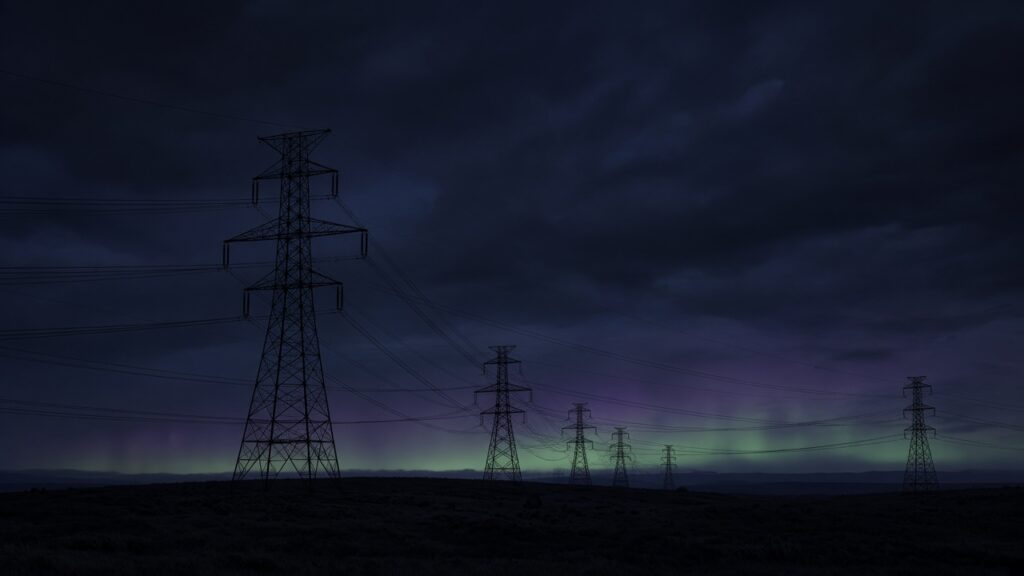
Search interest in solar flare emp risk usually collapses two different physical stories into one phrase. One story is natural space weather: a solar eruption drives a geomagnetic disturbance (GMD) that induces quasi-direct currents in long transmission lines and can stress high-voltage transformers. The other is nuclear high-altitude electromagnetic pulse (HEMP)—an intentional weapon effect with early-time electronics damage that solar storms do not produce. Official U.S. homeland-security and energy documents keep those hazards in separate boxes while still treating both as cascading infrastructure problems. This explainer stays on the solar side, uses NOAA baselines, and maps how extreme GMD can propagate from the bulk power system into payments and logistics without borrowing prepper mythology.
The systemic-risk framing matches how Insider Release covers other low-probability, high-consequence infrastructure failures in its reading of global catastrophic risks in 2026: cascades matter more than a single spectacular failure mode.
What Solar Flare EMP Risk Means on the Grid
Flare, CME, and Geomagnetic Storm — Three Linked Steps
A solar flare is an intense burst of electromagnetic radiation from the Sun. A coronal mass ejection (CME) is a bulk launch of magnetized plasma. When an Earth-directed CME arrives—typically hours to a few days later—it can disturb Earth’s magnetic field and drive a geomagnetic storm. NOAA’s Space Weather Prediction Center (SWPC) communicates storm severity on the G-scale, tied to the planetary Kp index. Public “solar flare EMP” language often skips that chain and jumps straight to fried gadgets. The grid-relevant physics sits in the GMD step, not in the X-ray flash alone.
SWPC’s impact guidance for electric power transmission describes the process in operational terms. Rapid changes in the geomagnetic field induce geoelectric fields in the ground. Those fields drive geomagnetically induced currents (GIC) through grounded transmission networks. GIC is quasi-DC on timescales of tens of seconds to tens of minutes. It can push power transformers into half-cycle saturation, raise reactive-power demand, generate harmonics, heat transformer structures, and trip protective equipment that expects clean 60-hertz waveforms. Peak demand days make the same storm harder to ride through.
Geomagnetically Induced Currents, Not a Household EMP Myth
Consumer electronics are not the primary casualty path in a severe solar GMD. The documented exposure surface is long conductors: high-voltage lines, some pipelines, and other grounded networks that couple to the geoelectric field. That is why planners talk about extra-high-voltage transformers, capacitor banks, and voltage-stability margins—not about every phone on a nightstand. Confusion persists because popular media borrows the word “EMP” from nuclear-weapon literature and applies it to any magnetic disturbance. Precision is the first editorial filter.
None of this makes extreme GMD harmless. NOAA’s G5 description explicitly lists widespread voltage-control problems, protective-system misoperations, possible grid collapse or blackouts, and transformer damage risk. The honest statement is narrower and harder: the hazard is systemic and slow relative to a nuclear E1 pulse, yet still capable of regional or multi-region outages if transformers and operating procedures fail under stress.
Solar GMD Versus Nuclear HEMP
Different Physics, Shared Vocabulary Problem
The Department of Homeland Security’s October 2018 Strategy for Protecting and Preparing the Homeland Against Threats of Electromagnetic Pulse and Geomagnetic Disturbances separates the terms by statute and by physics. EMP, in that NDAA-derived framing, means a pulse from a nuclear or nonnuclear device, including terrorism. GMD means a geomagnetic disturbance from a solar storm or other natural event. HEMP from a high-altitude nuclear detonation produces three components often labeled E1, E2, and E3. E1 is a fast, high-amplitude pulse that can upset or damage electronics. E2 is intermediate and sometimes compared—imperfectly—to lightning-like coupling. E3 is a late-time, low-frequency disturbance that can induce currents in long lines.
Solar GMD does not generate a nuclear E1. Equating a Carrington-class storm with “every chip dies” is a category error. Readers hunting solar flare emp explainers deserve that correction up front, even when the search phrase itself is imprecise.
Where E3 Overlaps — and Where It Does Not
DOE and industry waveform guidance is blunt: assessing E3 HEMP impacts on the bulk power system resembles assessing severe GMD, with important distinctions. E3 fields are shorter in duration—often tens to hundreds of seconds—while GMD can persist for hours or days with multiple peaks. Peak E3 environments in bounding analyses can also exceed typical severe-GMD geoelectric fields. DOE’s CESER waveform application material warns that E3 assessment results should not be used to quantify severe GMD effects, and the reverse. Shared vocabulary about transformer saturation and voltage collapse does not license interchangeable numbers.
For homeland-security planning, the practical implication is dual bookkeeping. Nuclear HEMP raises electronics-hardening and intentional-threat questions. Extreme solar GMD raises forecasting, transformer thermal margins, spare-equipment logistics, and multi-day operating procedures. Both can cascade across critical infrastructure sectors. They are not the same incident.
NOAA Baselines — SWPC Products and the G-Scale
G1 to G5 in Plain Language
NOAA’s Space Weather Scales give the public and operators a common severity ladder for geomagnetic storms:
- G1 (Minor, Kp=5): weak power-grid fluctuations possible.
- G2 (Moderate, Kp=6): high-latitude systems may see voltage alarms; long-duration storms can stress transformers.
- G3 (Strong, Kp=7): voltage corrections may be required; false alarms on some protection devices.
- G4 (Severe, Kp=8): possible widespread voltage-control problems; protective systems may trip key assets.
- G5 (Extreme, Kp=9): widespread voltage-control and protective-system problems; some grids may experience complete collapse or blackouts; transformers may experience damage.
Average frequencies on the same NOAA table place roughly four G5 days per 11-year solar cycle—rare, not imaginary. Frequency language is statistical, not a promise that the next extreme event will wait for a convenient calendar.
What Operators Actually Receive
SWPC issues watches, warnings, and alerts keyed to K-index thresholds and storm categories. Geomagnetic storm watches can provide lead time when an Earth-directed CME is identified. Upstream solar-wind measurements tighten timing and confidence closer to arrival, often on the order of minutes to a couple of hours for higher-confidence warnings. Grid and satellite operators rely on that product stream for posture changes: reducing loading, delaying maintenance outages, adjusting reactive support, or protecting sensitive assets. NASA’s account of the May 2024 storm notes that SWPC notified power-grid and commercial-satellite operators ahead of impacts—the ordinary professional channel, not a secret early-warning myth.
Radio blackouts (R-scale) and solar radiation storms (S-scale) are separate NOAA ladders. They matter for HF communications, aviation polar routes, and satellite operations. They are not synonyms for GMD-driven GIC. Keeping the three scales distinct prevents another common conflation: every bright flare is not automatically a grid-collapse event.
Historical Scale Without the Prepper Script
Carrington 1859 as a Scale Reference Only
The September 1859 storm associated with Richard Carrington’s white-light flare observation remains the standard historical benchmark for extreme space weather. Telegraph systems experienced induced currents strong enough to disrupt service; some operators reportedly worked with batteries disconnected. Aurora was seen at unusually low latitudes. Modern society’s dependence on long transmission corridors, GPS timing, and just-in-time logistics makes a like-for-like replay far more consequential than 1859’s telegraph-era footprint. That contrast appears in DHS’s EMP/GMD Strategy appendix and in National Research Council severe-space-weather framing. It is a scale reference—not a prophecy engine, and not the SEO target of this page.
March 1989, Halloween 2003, and May 2024 G5
On 13 March 1989, a severe geomagnetic storm contributed to the collapse of Hydro-Québec’s grid. DHS summarizes the outcome as interruption of power to more than six million people for nearly nine hours. Contemporary technical accounts describe GIC-driven saturation, harmonics, and rapid protective trips that took the system down in under two minutes. The event remains the clearest modern North American proof that space weather can black out a major interconnected system.
The Halloween storms of late October 2003 reached extreme (G5) levels on NOAA’s scale. Impacts included satellite anomalies, aviation and HF disruptions, and GIC-related problems on some power systems; a short distribution outage in Malmö, Sweden, is frequently cited in the technical literature. North America avoided a Québec-scale collapse that week, which is evidence of both luck and operational learning—not proof that G5 is harmless.
In May 2024, a pileup of Earth-directed CMEs drove a G5 geomagnetic storm—the strongest to reach Earth in about two decades, per NASA and SWPC historical comparisons. Auroras pushed to unusually low latitudes. The storm stressed satellites and communications paths and forced operators onto alert footing. It did not reproduce a continental transformer-wipe narrative. That outcome is useful: extreme is observable, forecastable in part, and survivable with prepared grids—while still validating why NERC GMD standards exist.
Transformers, Standards, and Cascading Failure
Why Large Transformers Matter
Large, high-side wye-grounded power transformers on the bulk electric system are the hardware bottleneck in severe GMD scenarios. Half-cycle saturation increases hot-spot heating and reactive demand. A transformer that trips or fails is not a software reboot. Replacement lead times for extra-high-voltage units are measured in months to years under normal supply-chain conditions, which is why spare strategies and thermal assessments dominate planning documents. DOE’s 2019 GMD monitoring guidance treats GIC measurement, magnetometers, harmonics, and time-stamped operational data as the instrumentation needed to turn storm anecdotes into engineering evidence.
NERC, FERC, DOE, and DHS Paper Trails
U.S. reliability policy after FERC Order No. 779 pushed the industry through staged GMD requirements. NERC’s EOP-010 family addresses geomagnetic disturbance operations—procedures reliability coordinators and transmission operators must maintain. The TPL-007 family addresses transmission-system planned performance for GMD events: identify responsibilities, maintain models, run benchmark and supplemental vulnerability assessments, and perform transformer thermal impact assessments for applicable facilities (commonly framed around transformers with high-side, wye-grounded windings above 200 kV). FERC Order No. 830 and later approvals tightened benchmark definitions and data collection. DOE’s monitoring report calls these standards a necessary first step while noting NERC’s own acknowledgment that more work remains to understand GMD and optimize mitigations.
DHS’s EMP/GMD Strategy adds the cascade thesis in plain bureaucratic language. Extreme electromagnetic incidents can compromise one critical infrastructure sector, spill into others, and expand beyond the initial geography. Electricity, communications, water, and transportation are named as lifeline concerns. Mutual-aid assumptions that work for a hurricane can fail when many regions are stressed at once and communications themselves degrade. That is the document-led version of “cascading failure”—not a cinematic blackout collage.
Payments, Logistics, and Soft Systemic Context
Card networks, clearinghouses, fuel pumps, cold-chain warehouses, and rail signaling all assume continuous power and working telecommunications. A multi-day, multi-region outage converts a physics problem into a payments-and-logistics problem through ordinary interdependency. Industry scenario studies—such as the 2013 Lloyd’s/AER report on solar-storm risk to the North American grid—attempt to price that exposure. Those figures are scenario analyses, not NOAA measurements, and should be read as stress tests rather than forecasts. National Space Weather Strategy materials likewise flag compound impacts across power, communications, and transport.
Insider Release’s Systemic Risks lane already treats control-speed and infrastructure fragility as institutional problems—see the cascading-failure framing in military AI and autonomous weapons systemic risk. Extreme space weather belongs in the same analytic family: rare drivers, dense coupling, recovery timelines set by hardware and coordination, not by vibes.
INSIGHT — Why the Phrase Misleads and the Risk Remains Real
The marketable phrase solar flare emp wins searches and loses physics. Solar storms threaten grids mainly through GMD-driven GIC, with NOAA’s G-scale as the public severity language and NERC/FERC standards as the engineering response. Nuclear HEMP adds an E1 electronics problem solar weather does not bring. Historical anchors—Carrington for scale, 1989 Québec for proof, 2003 and May 2024 for modern G5 experience—support vigilance without apocalypse cosplay. The residual risk that matters for institutions is spare transformers, operating procedures, forecast lead time, and cross-sector dependency—exactly the paper trail DHS, DOE, and NERC already publish.
FAQs
Is solar flare EMP the same as a nuclear EMP?
No. Solar storms drive geomagnetic disturbances and GIC on long lines. Nuclear HEMP includes a fast E1 pulse that can damage electronics plus later components. Official DHS language separates EMP (device-caused) from GMD (solar/natural).
What does NOAA’s G5 rating mean for power systems?
G5 (Kp=9) is NOAA’s extreme geomagnetic-storm level. Listed power effects include widespread voltage-control problems, protective-system issues, possible blackouts or grid collapse, and potential transformer damage.
Did the May 2024 storm prove the grid is safe?
It proved a G5 event can occur with modern forecasting and operator notification without a Québec-1989 repeat in North America. It did not retire NERC GMD planning standards or transformer-risk analysis.
Why do planners worry so much about transformers?
GIC can saturate large grounded transformers, causing heating, harmonics, and reactive-power stress. Failed extra-high-voltage units are slow and costly to replace, which turns a temporary storm into a prolonged capacity problem.
Where should readers start for primary sources?
NOAA’s Space Weather Scales and SWPC products; DHS’s 2018 EMP/GMD Strategy; DOE’s GMD monitoring guidance; and NERC’s TPL-007 / EOP-010 GMD standards documents.
Takeaways
Solar flare emp risk, read carefully, is extreme space-weather GMD risk to the bulk power system—not a nuclear E1 event and not a guarantee that every consumer device fails. NOAA’s G-scale and SWPC watches/warnings are the operational baseline. Carrington 1859 sets historical scale; March 1989 proves blackout potential; May 2024 shows a modern G5 under active forecasting. NERC, FERC, DOE, and DHS documents already treat transformers, operating procedures, and cross-sector cascades as the real preparedness surface. Scenario economic studies can illuminate exposure; they do not replace engineering assessments.
Call to Action
Read NOAA’s G-scale tables and the DHS EMP/GMD Strategy before recycling secondary “solar EMP” threads. Prefer SWPC products, NERC standards language, and DOE monitoring guidance over unsourced survival blogs. Insider Release will keep publishing Systemic Risks explainers that attach catastrophic-sounding phrases to primary records. Corrections grounded in those records are welcome. Inflated gadget-fry claims without a citation are not.
AI disclosure: This article may include AI-assisted drafting; human editorial review (claim-check and source verification) precedes publication. Where used, accompanying images may be AI-generated or AI-supported and are illustrative, not archival government photographs. Editorial responsibility for publication remains with Insider Release. See our AI Use Policy.
— Insider Release
Insider Release — Declassified. Analysed. Explained.
You may also like
Military AI Autonomous Weapons: Systemic Risk Explained
AI Impacts Survey: What 1,580 AI Researchers Expect (and Fear)
Universe 25 Experiment: What Calhoun’s Mouse Utopia Really Showed
Sicily Desertification: What Italian and IPCC-Cited Figures Show About Aridity Risk
Catastrophic Risk Annex: CSA STAR for AI Controls Explained