
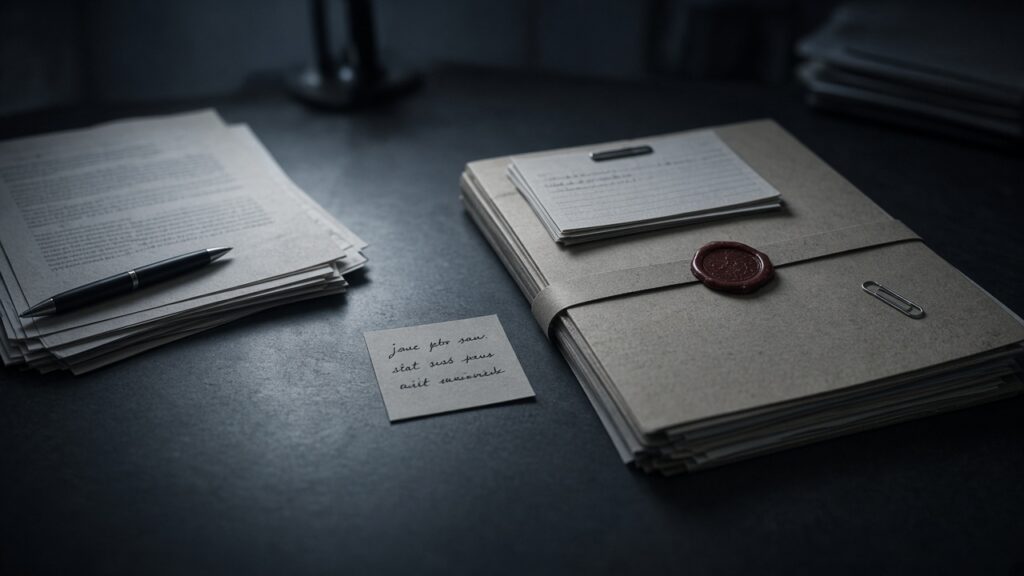
The wilson davis memo is a 15-page set of typed interview notes dated 16 October 2002, not a stamped Department of Defense finding. The header reads “EWD NOTES.” The attributed author is physicist Eric W. Davis. The attributed subject is a conversation with retired Vice Admiral Thomas R. Wilson, then recently out of the Defense Intelligence Agency. A public PDF of the same document family is available on DocumentCloud and was entered into the U.S. House hearing record on 17 May 2022 as supporting document HHRG-117-IG05-20220517-SD001.
That congressional filing preserved the text. It did not authenticate the meeting or the program claims inside it. Rep. Mike Gallagher asked hearing witnesses whether they knew the “Admiral Wilson memo” or “EW Notes.” They said they did not. Gallagher entered the PDF for the record while expressly declining to vouch for its veracity. Chairman Carson accepted it without objection. Visibility and verification are different things.
This explainer stays on the primary text: what the notes attribute to Wilson and Davis, what they withhold, what they fail to prove, and why authenticity remains contested. Later crash-retrieval and SAP-oversight debates echo the memo’s structural theme of contractor-held compartments. Those debates have their own Insider Release pages; this piece does not re-center them.
In this article
What the Wilson Davis Memo Is (and Is Not)
| Layer | Date or identifier | What it establishes |
|---|---|---|
| Typed notes | 16 October 2002; “EWD NOTES” | The date and attribution on the text, not independent confirmation of the conversation. |
| Public copy | DocumentCloud document 6185702 | An accessible copy; hosting is not authentication. |
| Congressional submission | 17 May 2022, supporting document SD001 | A 15-page document entered into the hearing record; filing does not validate its claims. |
Fifteen Pages of EWD NOTES, Not a DoD Finding
On its face, the PDF is reconstructed dialogue—interview notes, not an official government memorandum. Researchers also call the same packet “Core Secrets,” the Admiral Wilson memo, or EW Notes. Those labels point to one document family, not to separate authenticated releases.
The notes frame a roughly 70-minute talk in a car behind the EG&G Special Projects building at Grier and Paradise in Las Vegas, from about 10:10 to 11:20 a.m. An attached letter dated 25 April 2002, from retired Navy commander Willard (Will) Miller to Davis, offers consulting help on crash-retrieval research with explicit caveats: no classified materials, no name association, paid rates. That letter is part of the same PDF. Its offers are not verified leads.
Wilson’s open-source biography is not in dispute: he directed DIA from about July 1999 to July 2002 and retired around 30 August 2002. Davis’s public profile as a physicist with NIDS and later consulting work is likewise independent of whether every line in the notes is accurate. Verified résumés do not authenticate attributed dialogue.
How It Reached Congress Without Being Authenticated
Before the PDF went viral, versions of a Wilson “denied access” story already circulated in activist and journalistic channels tied to Steven Greer and Apollo 14 astronaut Edgar Mitchell. After Mitchell’s death in 2016, copies linked in public reporting to papers from his estate circulated privately, then appeared on Imgur and Reddit around 2018–2019. Researcher Richard Dolan amplified analysis of the document in 2019. That path is private circulation and community rediscovery, not a government declassification.
On 17 May 2022, during an open House Permanent Select Committee on Intelligence subcommittee hearing on unidentified aerial phenomena, Gallagher submitted the memo for the record. The hearing transcript shows Under Secretary of Defense for Intelligence and Security Ronald Moultrie and Navy Deputy Director of Naval Intelligence Scott Bray stating they were not aware of the document. Unanimous consent to enter a supporting PDF is record preservation, not a finding of fact. Politico’s 18 May 2022 wrap likewise treated the packet as unverified—closer to the transcript than claims that “Congress authenticated” the memo.
What the Notes Actually Say
The Alleged 2002 Las Vegas Meeting
According to the EWD NOTES, the meeting was arranged through Las Vegas contacts identified as Rich and Doug, with trust criteria and background checks emphasized. The notes quote Wilson saying that if trust were broken he would deny the meeting and everything said in it. That line sits inside the document. It is consistent with security tradecraft in a real conversation, and it is also consistent with a literary device in a fabricated one. The text alone cannot decide which.
The notes present Davis as interviewer and Wilson as speaker “TW,” and they recount Wilson’s alleged awareness of UFO subject matter through prior intelligence work and through Oke Shannon, a retired Los Alamos physicist who—according to the notes—vouched for Davis.
The 1997 Search Narrative Attributed to Wilson
The core story the transcript attributes to Wilson begins in April 1997. The notes describe a Pentagon conference briefing involving Greer, Miller, and Mitchell, with Admiral Mike Crawford and General Patrick Hughes among those present. After the group session, Miller and Wilson allegedly spoke privately for about two hours about UFOs, MJ-12 lore, Roswell, and crashed craft or bodies.
Wilson, as quoted, then searched special-program records groups associated with the Office of the Under Secretary of Defense for Acquisition and Technology after suggestions tied in the notes to General M. Ward and an encounter involving former Defense Secretary Bill Perry. He allegedly found an unusual subset of unacknowledged, carve-out, or waived special access programs. The notes say he identified a top U.S. aerospace technology contractor that also held intelligence equities in its corporate portfolio. The contractor’s name is withheld in the text as a “core secret.”
In mid-June 1997, according to the notes, Wilson met in a contractor vault with a program director, a corporate attorney, and an NSA-retired security director—a “watch committee.” Access was denied: clearances valid, but not on the bigot list. A Senior Review Group / SAPOC process allegedly sustained the contractor’s denial, with career-threat language if he persisted. A January 1998 exchange attributed to Jacques Gansler advises dropping the matter (UFOs real; abductions not). Like the rest of the 1997 arc, it exists only as attributed dialogue.
The Reverse-Engineering Claims—and the Withheld Core Secrets
The program description the notes attribute to the contractor program manager is the passage most often excerpted online. It speaks of reverse engineering, an intact craft, and technology “not of this Earth—not made by man.” Progress is described as agonizingly slow. A workforce figure of about 400–800 people on the bigot list appears only inside the notes. The text also claims that no White House or congressional names appeared on the list Wilson was shown.
What the same pages refuse to supply matters as much as what they allege. There is no contractor name, no program code name, and no craft location. When the notes turn to Roswell, MJ-12, or Holloman-style prompts, the contractor is described as “mum.” Readers who treat the packet as a finished exposé are reading past the document’s own refusals.
Miller’s attached April 2002 letter lists possible research avenues while insisting on unclassified assistance only. Those remain offers on letterhead, not audited confirmations.
What the Notes Do Not Claim
Not Proof of Non-Human Hardware
Reconstructed dialogue is not an audited inventory. The PDF has no photographs, serials, budgets, or chain-of-custody pages. Phrases about an intact craft and non-terrestrial manufacture are claims inside notes—not independent physical evidence.
Not an Official Authentication by Congress or the Pentagon
Hearing witnesses in May 2022 said they were unaware of the document. Gallagher declined to comment on veracity. Entering a PDF under unanimous consent does not convert private interview notes into a DoD or AARO authentication of a contractor reverse-engineering program. Court FOIA dockets that force agencies to describe searches under oath—as in Insider Release’s coverage of the Grusch DoD FOIA summary-judgment fight—are a different provenance class from a privately circulated transcript later filed for the record.
Not a Named Contractor Exposé
The “core secret” withholdings are structural to the document. Insider Release will not invent a company name the notes refuse to print. Speculative contractor lists circulating on forums are not part of the primary PDF and are outside this explainer’s scope.
Contested Authenticity: Both Sides
Wilson’s Denials
Admiral Wilson’s public position, as reported by Billy Cox and others, is categorical: he denies meeting Eric Davis and calls the notes fiction. In an email to journalist Ross Coulthart quoted by Cox, Wilson described the entire memo—including characterizations of attitudes and people—as “pure fiction,” saying many named individuals were completely unknown to him. He has acknowledged a 1997 Mitchell UFO-related meeting while denying the Davis parking-lot interview and the hidden-UFO-SAP hunt as written. That denial is the strongest single counter-source in open reporting.
Davis’s Silence—and Later Authorship Signals
For years Davis answered with no comment. Press reporting linked copies to Mitchell estate papers. In 2024, researchers reported informal Davis language—“our meeting,” “my interview notes”—widely read as a tacit authorship signal. Authorship, if accepted, still does not swear that Wilson spoke every attributed sentence or that the 1997 contractor narrative is true.
Corroboration Gaps and Partial Corroborators
Proponents cite dense specificity about DoD offices, SAPOC/SAPCO processes, and named officials (Perry, Kaminski, Kostelnik, Gansler, Ward, Hughes, Daly). Specificity can support authenticity—or be rebuilt from open org charts. Pre-2019 oral tradition from Greer, Mitchell, and earlier Cox reporting shows a Wilson denied-access story existed before the PDF leaked; that is not proof of the 2002 notes.
Oke Shannon told Cox he knew Wilson and Davis, later affirming he “knew him” while refusing to contradict the admiral and offering “no comment” on the affair—partial social corroboration at best. Kit Green, in 2019 Dolan write-ups, declined to declare provenance legitimate. There is no public recording, no forensic authentication of an original manuscript, and no open DoD/AARO authentication of the alleged contractor program.
Editorial label: contested / unauthenticated. PDF existence in hearing materials: verified. Davis authorship: plausible/tacit in research circles; not formally sworn. Wilson meeting and program narrative: denied by Wilson; not independently corroborated by primary official records.
Timeline — From Notes to Public Record
1997–2002 — Events Inside the Notes
The document’s internal chronology runs from the alleged 9 April 1997 Pentagon briefing and Miller–Wilson private talk, through a May–June 1997 records search and contractor vault meeting, to the 25 April 2002 Miller letter and the 16 October 2002 Las Vegas interview dated on the EWD NOTES header. Only the letter’s date and the notes’ header date are on-document timestamps. The 1997 operational arc remains notes-only.
2019 Rediscovery — Mitchell Papers and Viral Circulation
After years of oral tellings, the PDF and page images spread online around 2018–2019. Public reporting linked circulation to Mitchell estate papers after 2017. Dolan’s “Core Secrets” framing pushed the packet into wider UAP-community attention. Wilson’s denials to Cox land in the same rediscovery window. Chain of custody stays private. It is not a National Archives release.
2022 Hearing Record — Visibility Without Verification
Gallagher’s 17 May 2022 submission placed the scanned PDF into official House supporting materials for event 114761. Calendar listings identify it as a Gallagher submission for the record. Readers can download the same text from congress.gov or DocumentCloud. Downloadability is not verification.
Later Oversight Debates (Soft Context Only)
From 2023 onward, crash-retrieval allegations, SAP oversight, and historical UAP record-keeping debates intensified. The memo’s structural claim—a contractor-held compartment beyond normal need-to-know—rhymes with those arguments; rhyme is not identity. Official historical-report gaps in Insider Release’s AARO Volume II still missing explainer are a separate problem from unverified notes. Declassification and Glomar fights in the UAP Science Advisory Council declassification requests piece are a different instrument. Contested cases such as Immaculate Constellation raise similar provenance questions without merging topics. This article stays on the Wilson–Davis text.
INSIGHT — Why Document Discipline Matters Here
The memo’s public power is as a primary text about alleged oversight failure—not proof of non-human hardware. A private note can shape questions about bigot lists, carve-out SAPs, and what a senior officer can compel from a contractor without becoming evidence of extraterrestrial recovery. Track what is on the page: access denial, gatekeeping language, withheld core secrets. Activist inference is a separate layer.
The institutional question is not a culture-war choice between Davis and Wilson. It is whether any mechanism can test, under oath and with records, the structural claim of a compartment beyond normal SAP oversight. Until then, the honest label remains contested and unauthenticated.
FAQs
Is the wilson davis memo an official U.S. government memorandum?
No. It is a set of private EWD NOTES later placed in a House hearing supporting-document file. Congressional filing preserves the PDF; it does not turn the notes into a DoD directive or finding.
Did Congress authenticate the Wilson–Davis memo?
No. Unanimous consent to enter a document for the record is not a finding of fact. Gallagher stated he was not commenting on veracity. Hearing witnesses said they were unaware of it.
What does Admiral Wilson say about the memo?
As reported by Billy Cox and others, Wilson denies meeting Davis, calls the document fiction, and has used “pure fiction” language about the memo’s characterizations. He has acknowledged a 1997 Mitchell UFO-related meeting while rejecting the Davis interview and the SAP-hunt narrative as written.
Did Eric Davis write the notes?
Davis long gave no comment. Later informal language reported in 2024 is treated by many researchers as an authorship acknowledgment. Even if Davis authored the notes, that does not independently verify Wilson’s attributed words or the 1997 program claims.
Does the memo prove a crash-retrieval program?
It claims one in attributed dialogue—reverse engineering, an intact craft, non-terrestrial manufacture—while withholding the contractor name and location. Those claims are not audited proof.
Takeaways
The wilson davis memo is a 15-page interview record dated 16 October 2002—readable on DocumentCloud and in the May 2022 House supporting PDF—not a DoD authentication. The notes allege Wilson found a contractor reverse-engineering effort and was denied access; they withhold the identifying “core secrets.” Congressional filing raised visibility without verifying substance. Wilson denies the meeting and calls the packet fiction; Davis authorship is contested-to-tacit; the program narrative remains unproven in open official records. Soft parallels to later oversight debates do not merge those topics here.
Call to Action
Read the primary PDF yourself on DocumentCloud or congress.gov before recycling secondary summaries. Prefer the House supporting document and the hearing transcript over unsourced social threads. Insider Release will keep publishing document-led UAP Disclosure explainers that separate primary text from rumor. Corrections grounded in the PDF, the transcript, or named on-the-record denials are welcome. Speculation without a citation is not.
Correction, 7 October 2026: An earlier version gave 2017 as Edgar Mitchell’s year of death. It has been corrected to 2016, consistent with NASA’s remembrance.
Insider Release — Declassified. Analysed. Explained.
Related reading: more document-led UAP analysis in the UAP disclosure hub.