
Los Alamos UAP & Teller Meetings: The 1950 Report Finally Surfaces
On 8 May 2026 the Department of War posted the first major tranche of the PURSUE archive to war.gov/UFO. Among the 1940s and 1950s intelligence files sits a single 1950 USAF district commander’s report that deserves more attention than it has received so far.
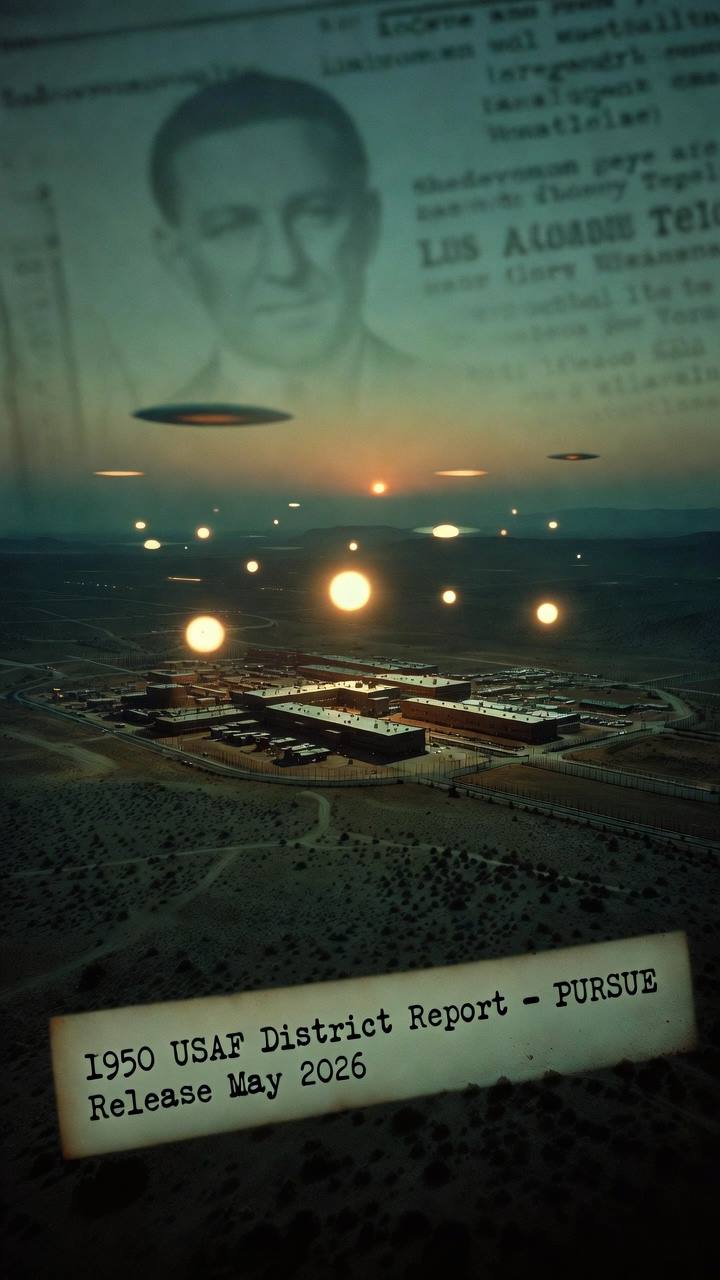
The document describes repeated sightings of unusual aerial objects in the immediate vicinity of Los Alamos National Laboratory. Laboratory employees and military pilots reported the phenomena. In the weeks that followed, high-level meetings took place. One attendee was Edward Teller, the physicist already known inside government circles as the driving force behind the hydrogen bomb.
These pages have sat in classified storage for seventy-six years. Their release is not accompanied by dramatic claims or new conclusions. It simply places the original record in public view. At Insider Release we read the file in full, cross-referenced the dates against the broader Cold War timeline, and placed it alongside the rest of the May 2026 drop. The result is a clearer picture of how seriously some officials treated UAP activity near the nation’s most sensitive nuclear facilities even in the earliest years of the atomic age.
The 1950 USAF District Report – Primary Source
The core document is a formal report submitted by a U.S. Air Force district commander responsible for the Los Alamos area. It records multiple incidents in which laboratory staff and visiting pilots observed strange objects in the sky above and around the secure site.
Descriptions include bright lights that appeared suddenly, objects that hovered or moved at speeds inconsistent with known aircraft of the era, and at least one instance of a disc-like shape. The report notes that the sightings occurred over a concentrated period and that witnesses included trained observers who were not prone to exaggeration.
Importantly, the commander does not speculate on origin. He records the observations, notes the proximity to classified nuclear work, and recommends further inquiry. That recommendation appears to have been acted upon.
The language is dry, bureaucratic, and precise. No mention of “flying saucers” in the sensational press sense. Just “unidentified aerial phenomena” near a facility whose work was considered existential to national survival.
The Follow-Up Meetings and Teller’s Presence
What elevates this file beyond routine sighting logs is the evidence of subsequent high-level discussion. The PURSUE release includes references to meetings convened in the wake of the sightings. Edward Teller attended at least one.
Teller was not a casual participant in 1950. He was already the leading advocate for accelerating thermonuclear weapons development. His presence at a meeting triggered by aerial anomalies over Los Alamos suggests the sightings were taken seriously enough to warrant briefing one of the most influential scientific voices in the national security apparatus.
The released pages do not transcribe the full conversation. They note the meeting occurred, list participants, and record that the group reviewed the commander’s report. No final determination appears in the declassified excerpt. The file simply ends with the observation that the matter warranted continued monitoring.
This is classic Cold War documentation: serious people treating an unexplained problem with bureaucratic caution rather than public alarm.
UAP Near Nuclear Assets – Pattern Recognition
Los Alamos was not an isolated case even in 1950. The broader tranche contains other intelligence summaries from the same period that reference phenomena near military installations and atomic sites. The pattern is consistent enough that it cannot be dismissed as coincidence or misidentification alone.
Nuclear facilities represent concentrated high-value targets. They are heavily guarded, heavily instrumented, and central to strategic deterrence. Any unexplained object operating in their airspace would trigger immediate security protocols. The fact that reports reached district-commander level and then moved upward to figures like Teller indicates the observations passed initial filters for credibility.
The 2026 release does not prove hostile intent or extraterrestrial interest in American nuclear weapons. It does demonstrate that the government documented repeated incursions or overflights near its most protected assets and chose, for decades, to keep those records out of public circulation.
Placing the Los Alamos File in the 2026 Context
The PURSUE archive deliberately mixes eras. A 1949 “flying discs” intelligence summary sits near the 1950 Los Alamos report. FBI orb cases from 2023 appear in adjacent folders. The message is chronological continuity: UAP reporting did not begin in 2017 or 2021. It runs through the entire modern history of American national security.
The Los Alamos document gains additional weight because it predates the modern UAP stigma. In 1950 there was no widespread cultural dismissal of the topic. Observers reported what they saw without fear of professional ridicule. That raw quality makes the file valuable for researchers trying to separate signal from later noise.
At the same time, the release remains partial. Redactions persist in places. Context around what happened after the Teller meeting is thin. Future tranches may fill those gaps. For now the 1950 report stands as a clear marker that concerns about UAP activity near nuclear infrastructure existed from the very beginning of the atomic era.
Implications for Systemic Risk Assessment
Nuclear sites are not merely industrial facilities. They are nodes in a global system of deterrence whose failure could produce catastrophic outcomes. Any unexplained phenomenon operating in their vicinity raises legitimate questions about perimeter security, sensor coverage, and command-and-control resilience.
The 1950 report does not claim the objects interfered with operations. It simply records their presence in numbers sufficient to prompt high-level attention. That alone is noteworthy. In an era when the United States was racing to build a thermonuclear arsenal, even brief unexplained activity near Los Alamos would have been treated as a potential intelligence or sabotage concern.
The slightly cynical view is that the government has long understood the sensitivity of these locations yet only now feels comfortable releasing the oldest examples. The more constructive view is that transparency on historical cases can inform current risk models. If similar phenomena continue to appear near nuclear assets in 2026, the 1950 precedent suggests the pattern is durable rather than episodic.
INSIGHTS
The primary source is the 1950 USAF district commander’s report released under PURSUE on 8 May 2026 and hosted at war.gov/UFO. It appears in the Department of War folder alongside related 1948–1955 intelligence numeric files. Edward Teller’s attendance is noted in the meeting summary attached to the same release tranche.
Supporting material includes the All-domain Anomaly Resolution Office (AARO) 2025 Information Paper on declassification processes, which explains how historical UAP records are reviewed for public release. The National Archives and Records Administration’s Record Group 615 (Unidentified Anomalous Phenomena Records Collection), established under the 2024 NDAA, now incorporates several early Cold War documents from this same period.
These sources are valuable because they are original government records rather than later summaries. Researchers can download the PDFs directly, compare the 1950 timeline against known Los Alamos activities, and assess the credibility of the reporting chain for themselves. Until the May 2026 drop, equivalent material required lengthy FOIA processes that frequently returned heavily redacted or “no records” responses.
FAQs
Did Edward Teller believe the Los Alamos objects were extraterrestrial? The released pages do not record Teller’s personal conclusions. They confirm only that he attended at least one meeting convened to review the USAF commander’s report. His involvement signals the sightings were treated as a serious national-security matter.
Were the 1950 objects interfering with nuclear operations? The document does not describe any disruption to laboratory functions or weapons work. It records visual observations in the airspace above and around the site and recommends continued monitoring.
Why release this particular file now? The PURSUE directive prioritises historical records that no longer carry active classification risk. The 1950 report meets that criterion. Its release also aligns with the administration’s stated goal of maximum transparency on UAP matters.
Is there a broader pattern of UAP near nuclear sites? Yes. The 2026 tranche contains additional references to phenomena near military and atomic installations from the same era. Independent researchers have long noted similar clusters in later decades. The Los Alamos file adds an early, well-documented data point.
Could these simply have been misidentified aircraft or balloons? The reporting officer considered conventional explanations and still forwarded the case upward. The concentration of sightings over a short period near a heavily restricted site made routine misidentification less likely in the eyes of those who reviewed the reports at the time.
Will more Los Alamos or nuclear-related files appear in future tranches? The Department of War has indicated additional materials will be posted on a rolling basis. Historical records from atomic and missile sites are explicitly within scope.
How does this affect current nuclear security thinking? It provides historical precedent. If unexplained objects operated near Los Alamos in 1950 with enough frequency to trigger high-level meetings, similar activity today would warrant equivalent scrutiny regardless of origin.
Takeaways
The 1950 Los Alamos report is not a smoking gun. It is a bureaucratic record of unexplained aerial activity near one of the most sensitive sites in the American nuclear enterprise, followed by a meeting that included one of the era’s most influential defence scientists.
Its appearance in the 2026 PURSUE release removes any remaining excuse that early UAP concerns were confined to fringe observers or press sensationalism. Trained personnel at a classified nuclear laboratory reported repeated anomalies. The chain of command took the reports seriously enough to brief Edward Teller. That chain of events is now public.
At Insider Release we treat such documents as data points, not proof of any particular theory. The pattern of UAP activity near nuclear assets deserves systematic study precisely because the stakes are existential. The 1950 file is one more piece of that puzzle, finally freed from the vault.
Call to Action
Download the original 1950 report from war.gov/UFO and compare it with the surrounding intelligence files. Then share your observations in the comments below. For deeper context on UAP near sensitive sites, read our analysis of the Apollo astronaut transcripts and the practical guide to navigating the full PURSUE archive. Additional tranches are expected within weeks; we will continue parsing them as they arrive.
Disclaimer: This article was created with the partial or full assistance of artificial intelligence. The text and all accompanying images were generated or significantly supported by AI tools.
Insider Release
Declassified. Analyzed. Explained.
You may also like
DOE OICI UAP FOIA: What Energy Intelligence Releases (and Withholds)
CIA Stargate Documents Explained: What’s in the CREST Remote-Viewing Files (and How to Read Them)
Why Is AARO Buying Private Pre-1990 UAP Archives?
What Does Grusch’s UAP NDA Waiver Actually Allow?
NARA UAP Records Collection: What’s in RG 615