
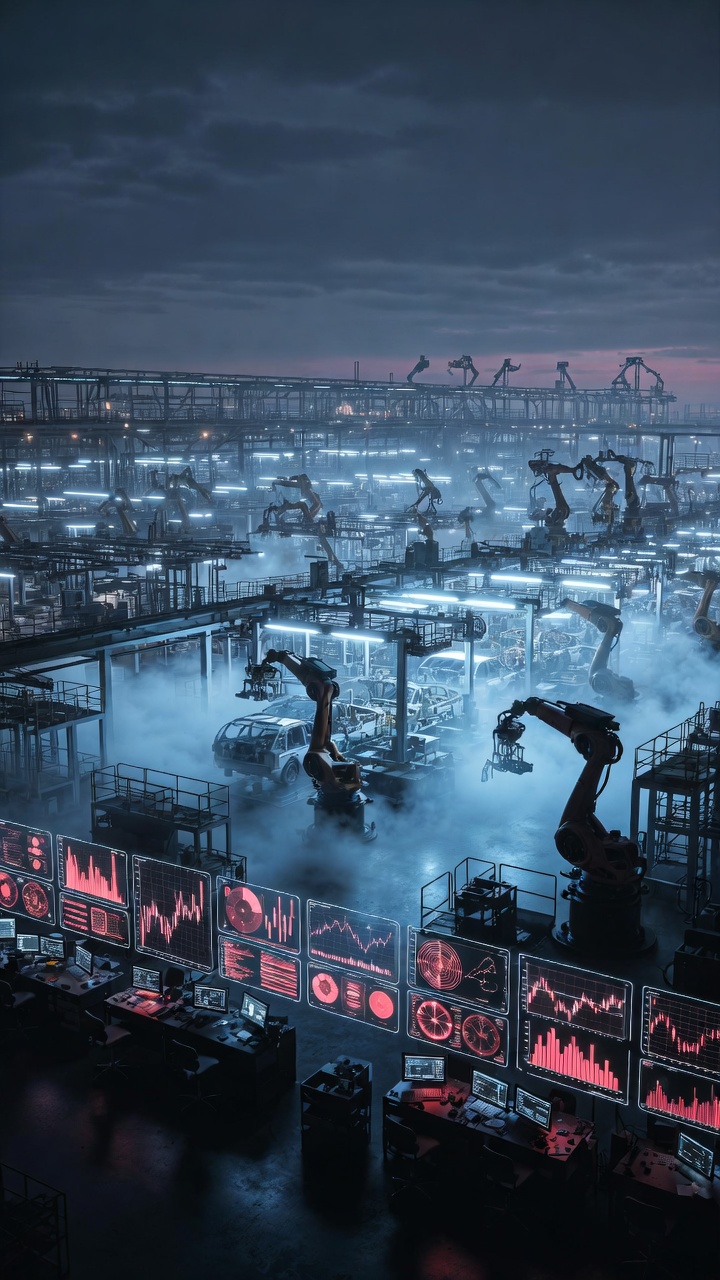
The economic risks of robotics and AI include job transitions, unequal gains and pressure on household incomes. The scale depends on adoption, new demand, worker retraining and policy choices. Current research measures exposure and models possible outcomes; it does not establish an inevitable decline in employment.
This guide distinguishes employer projections, task exposure and observed job losses. Those measures answer different questions and should not be treated as interchangeable evidence.
In this article
Jobs and automation: what the data measure
Landmark Studies Reveal the True Scale
The foundational 2013 Oxford Martin School paper by Frey and Osborne estimated 47 percent of US jobs faced high computerization risk. Their 2023 reappraisal, accounting for generative AI breakthroughs, expanded that frontier: many tasks involving social interaction or creative recombination now show partial vulnerability, especially in remote or structured settings. Persistent limits around trust and hallucination remain, yet the trajectory is unmistakable.
The IMF’s 2024 Staff Discussion Note on Generative AI and the Future of Work places exposure at 60 percent of jobs in advanced economies and 40 percent in emerging markets. The World Economic Forum Future of Jobs Report 2025, drawing on more than 1,000 employers representing 14 million workers, projects that by 2030 structural change will affect 22 percent of current formal employment: 170 million new roles created against 92 million displaced, yielding a projected net gain of 78 million. Beneath the headline net lies severe churn, with clerical, administrative and routine cognitive positions facing the largest absolute losses. Forty-one percent of surveyed employers already plan workforce reductions due to AI by decade’s end.
McKinsey Global Institute modeling quantifies the upside—generative AI alone could add $2.6 trillion to $4.4 trillion in annual economic value, potentially doubling with broader embedding—yet stresses that realizing these gains requires unprecedented workforce redeployment. The same research shows current technologies could automate activities consuming 60 to 70 percent of employee time.
Physical Robotics Extends the Pressure
Software AI disrupts services; embodied robotics brings the same logic to manufacturing, logistics, agriculture and care work. China accounts for roughly half of global industrial robot installations. Western firms accelerate deployment of AI-enhanced systems capable of unstructured environments. The gap between cognitive and physical automation narrows yearly. Once reliable navigation and manipulation reach human levels in homes, hospitals or warehouses, entire service categories face compression that earlier automation waves never achieved.
Speed remains the critical variable. Previous industrial transitions unfolded over decades, allowing labor markets time to adjust. Current trajectories compress that window into years, raising the probability that displacement outruns both retraining capacity and new job creation.
Inequality, wages and consumer demand
Concentration of Gains and Labor Share Decline
Automation can change the distribution of income, but its effects depend on adoption, complementary investment and labor-market institutions. The IMF’s January 2024 staff discussion note analyzes both potential productivity gains and inequality risks. Exposure is not a count of jobs already lost.
This article does not rely on the earlier, insufficiently sourced assertion that almost one billion jobs face imminent disruption. Emerging-market outcomes require country-specific analysis rather than a single global loss figure.
The Demand-Side Feedback Loop
Productivity gains sustain broad growth only when displaced workers secure new productive employment and retain purchasing power. When automation concentrates income among high savers while hollowing out middle- and lower-income jobs, aggregate demand weakens. This dynamic—productivity rising while the consumer base erodes—represents the central economic risk from the robotics and AI revolution. IMF macro workshops explicitly flag this channel as a potential source of fiscal and financial instability. Consumer spending constitutes 60–70 percent of GDP in most advanced economies; any sustained erosion there transmits directly into slower growth, reduced investment and further pressure on employment.
Geopolitical and financial stability risks
Dependence on chips, components and digital services creates channels through which supply interruptions or cyber incidents can affect production. That is a scenario to assess, not evidence that AI has already caused a particular macro-financial crisis. The previously cited, insufficiently identified “IMF May 2026” cyberattack analysis has been removed.
A useful assessment identifies the affected system, dependencies, plausible failure mechanisms and tested recovery measures before estimating a wider economic impact.
Policy choices and worker transitions
The data does not dictate catastrophe. Earlier technological leaps ultimately raised living standards, yet only after societies constructed new institutions—public education, social insurance, progressive taxation and labor protections. The present wave arrives with thinner buffers and greater velocity.
Viable responses under active discussion include automation-specific levies to fund retraining, portable benefits untied to single employers, expanded lifelong learning accounts and coordinated international standards on data and model governance. None offer painless solutions; all demand political capital that has proven difficult to mobilize. The IMF and OECD continue urging updates to social protection systems precisely because frameworks designed for an industrial economy fit poorly in an algorithmic one.
The alternative—continued hands-off acceleration—compounds risks. Regional concentrations of displacement could re-emerge at continental scale. Institutional trust, already fragile, frays further when growth feels abstract while insecurity feels immediate. Historical episodes remind us that technological unemployment rarely remains purely economic; it frequently spills into politics and, at times, unrest.
INSIGHT: Primary Sources Illuminating Economic Risks from the Robotics and AI Revolution
The IMF January 2024 staff discussion note studies AI exposure and macroeconomic implications. Its estimates concern potential task exposure, including opportunities for complementing workers, rather than confirmed displacement.
The World Economic Forum’s Future of Jobs Report 2025 reports employer expectations for 2025–2030: 170 million roles created and 92 million displaced across multiple structural trends, for a projected net increase of 78 million. Those totals are not an AI-only forecast or an observed employment result.
Compare definitions, forecast periods, samples and assumptions before combining estimates. This source guide removes the earlier, insufficiently identified Oxford reappraisal and other unlinked statistics.
FAQs
How large are the economic risks from the robotics and AI revolution by 2030?
The WEF 2025 report projects 170 million jobs created and 92 million displaced by 2030: a net gain of 78 million, not 90–100 million net losses. These employer-based projections cover several structural trends, not AI alone; they are not observed outcomes. Individual workers and regions can still experience serious transition costs.
Will new jobs fully compensate for losses?
WEF 2025 data projects modest net employment growth, yet the quality, location and skill requirements of new roles differ sharply from those displaced. Historical transitions required decades; current speed compresses adjustment timelines.
Which sectors face the highest exposure?
Manufacturing, logistics, warehousing, transportation and healthcare support already see accelerated robotics deployment. White-collar pressure rises fastest in data processing, customer service, legal support and basic financial analysis.
Can policy reduce these economic risks?
Targeted measures—automation levies, portable protections, large-scale reskilling and international coordination—have precedent and modeling support. Effectiveness hinges on timing and political commitment; delay narrows viable options.
How do developing countries fare differently?
ILO-linked analysis indicates higher relative vulnerability because pathway jobs are more automatable and safety nets thinner. Economies with strong digital foundations may leapfrog; others risk premature deindustrialization and stalled mobility.
Does this differ fundamentally from past revolutions?
The substitution mechanism is familiar. Differences lie in velocity, dual physical-cognitive scope and extreme concentration of ownership and returns. Earlier waves benefited from stronger institutional shock absorbers.
What the evidence means
Economic Risks from the Robotics and AI Revolution manifest in concrete data: widespread exposure, concentrated gains, eroding labor share and latent demand destruction. The technologies deliver genuine productivity advances and new value frontiers. Yet the same evidence that documents these gains also reveals structural vulnerabilities that unmanaged rollout could convert into instability.
The 2026 risk landscape, as framed by the World Economic Forum and IMF analyses, places adverse AI and robotics outcomes among the most consequential long-term threats precisely because they intersect economic performance, social cohesion and financial stability. Pretending distributional and demand-side consequences will resolve themselves increases the probability that adjustment arrives through crisis rather than design.
A coherent response remains feasible. It begins with honest recognition that technology is a tool, not an autonomous force, and that institutions must evolve at least as rapidly as the machines they govern. The alternative is a more polarized global economy in which aggregate abundance coexists with widespread precarity. The data sits on the table. The choices societies make in the next few years will determine whether the robotics and AI revolution broadens prosperity or deepens existing divides.
Call to Action
How do you see economic risks from the robotics and AI revolution playing out in your industry or region? Share your observations in the comments. For continued coverage of systemic threats, labor-market transformation and policy responses, browse our latest reports. Follow Insider Release for evidence-driven analysis of the forces reshaping economies and societies.
Insider Release
Declassified. Analyzed. Explained.