
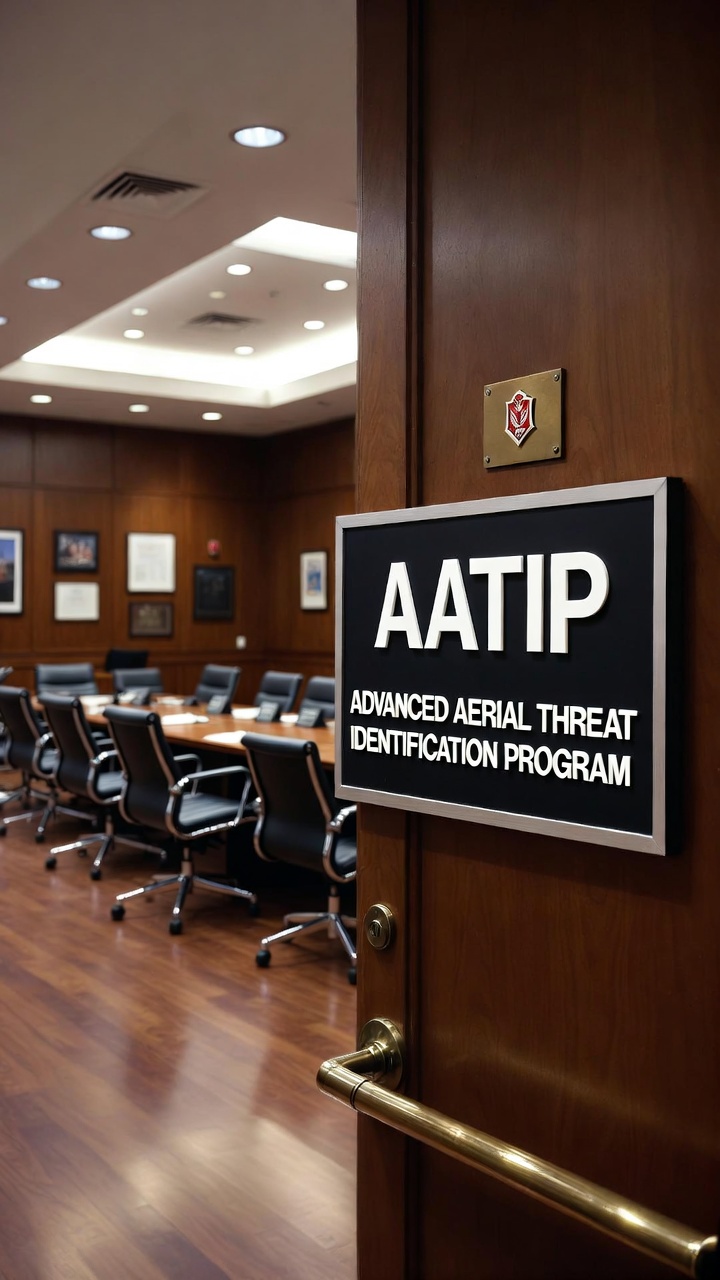
When a cache of internal Pentagon emails surfaced in May 2019, it offered a rare glimpse behind the curtains of the United States’ most publicised secret programme – the Advanced Aerospace Threat Identification Program (AATIP). The correspondence, exchanged between senior officials such as Neill Tipton, the former Director of the DoD’s Office of the Under Secretary of Defense for Intelligence, and a handful of analysts, reveals an intentional, top‑down effort to align the department’s narrative about AATIP and its most visible spokesperson, Luis Elizondo. The timing is striking: the emails arrived just months before the Department of Defense officially acknowledged the existence of Unidentified Aerial Phenomena (UAP) in a historic report to Congress.
For readers of Insider Release – a community that pries open declassified material, examines policy contradictions, and questions the machinery of secrecy – the significance is twofold. First, the documents expose a coordinated messaging strategy that contradicts the public claim of a “bottom‑up” investigation into anomalous aerial objects. Second, they illustrate how the Department of Defense managed both internal disagreement and external scrutiny while attempting to preserve credibility.
This article dissects the email trail, places it within the broader AATIP timeline, and evaluates what the revelations mean for government transparency, congressional oversight, and future declassification efforts. By the end, the reader will understand not only what the emails say, but why the DoD felt compelled to shape the public discourse in the way it did.
Background: AATIP and the Public Narrative
Origin and Funding of AATIP
The Advanced Aerospace Threat Identification Program was launched in 2007 under the tenure of then‑Secretary of Defense Robert Gates. Funded initially with $22 million – a modest sum in defence budgeting terms – AATIP was designed to investigate reports of “unidentified aerial phenomena” that could potentially threaten national security. Official documents, released through the Freedom of Information Act in 2017, detail a modest staff, a handful of contractors, and a focus on data collection from pilots, radar operators, and sensor platforms.
Publicly, the program was portrayed as a low‑key, science‑driven effort, largely insulated from political influence. The narrative emphasized rigorous analysis, a cautious approach to speculation, and a promise to keep any classified findings within the confines of the intelligence community.
Luis Elizondo Emerges as the Face of AATIP
Luis Elizondo, a career intelligence officer who previously served in the Air Force Office of Special Investigations, entered the public arena in 2017 when he resigned from the Pentagon and gave an interview to The New York Times. In that interview, Elizondo claimed to have led AATIP and to have overseen a trove of compelling footage allegedly showing “physics‑defying” behaviour. His statements propelled AATIP from a footnote in defence budgets to a headline‑making story across mainstream media.
For many observers, Elizondo became synonymous with the “UFO” discussion, a convenient point of contact for journalists and a charismatic figure for advocacy groups. However, the May 2019 email cache suggests the Pentagon was acutely aware of Elizondo’s growing influence and took deliberate steps to frame his role within a controlled narrative.
The May 2019 Email Cache: What Was Released?
Discovery and Publication
The emails first appeared on The Black Vault, a well‑known repository for government documents. The release comprised roughly 70 messages dated between April and June 2019, exchanged primarily among senior DoD officials in the Office of the Under Secretary of Defense for Intelligence, the Office of Public Affairs, and a small group of analysts attached to the AATIP project.
Key participants included Neill Tipton, then‑Deputy Assistant Secretary of Defense for Security, and a senior public‑affairs officer, identified only as “J. M.” The correspondence was marked “UNCLASSIFIED//FOR OFFICIAL USE ONLY” – a classification level that allows wide distribution within government but still requires a formal release for public consumption.
Key Participants and Their Roles
d>Raised concerns about internal contradictions.
| Name | Position (May 2019) | Relevant Action |
|---|---|---|
| Neill Tipton | Deputy Assistant Secretary of Defense (Security) | Authored the initial directive to align AATIP messaging. |
| J. M. (Public Affairs) | Senior Public‑Affairs Officer, OUSD(I) | Tasked with drafting talking points for media engagements. |
| R. S. (Analyst) | Intelligence Analyst, AATIP | |
| L. E. (Luis Elizondo) | Former AATIP Lead (no official DoD role in 2019) | Referenced in emails as a “public spokesperson”. |
Coordinated Messaging Effort: Inside the Directive
Internal Instructions to Shape the Narrative
The most telling email, dated 7 May 2019, begins with a subject line that reads “AATIP Messaging Alignment – Immediate Action Required”. Tipton writes:
“We need a unified talking point set for any external inquiry on AATIP. Luis’ public statements must be mirrored by official DoD language to avoid perception of a rogue element within the department. Draft revisions will be circulated by 12 May.”
Within hours, a second email from J. M. follows with a draft set of bullet points, explicitly positioning Luis Elizondo as “a former project lead now serving as an independent consultant” and emphasizing that “AATIP remains a classified effort, and any public discussion is limited to unclassified data already released”.
The tone of these memos is pragmatic rather than defensive. Rather than denying the existence of AATIP, the officials opted to steer the conversation toward a controlled narrative – one that acknowledges the program while limiting the scope of speculation.
Contradictions Uncovered by the Email Trail
While the directive seeks consistency, a separate thread reveals internal friction. An analyst, identified as R. S., sent a confidential note to Tipton on 9 May, stating:
“The proposed language downplays the significance of recent data releases. If we present AATIP as a ‘low‑key’ effort while Luis continues to tout “groundbreaking” footage, we risk a credibility gap that could invite congressional scrutiny.”
Tipton’s reply, essentially dismissive, reads:
“Focus on the message, not the perception. Our priority is to prevent a narrative that suggests the DoD is out of control. The public is not the arena for internal debate.”
This exchange highlights a classic tension: the desire to project confidence versus the reality of divergent internal assessments. The emails make clear that the DoD was consciously managing the image of AATIP, even as some staff feared that the approach might backfire.
Implications for Transparency, Oversight, and Public Trust
Impact on Congressional Oversight
In July 2020, the Senate Armed Services Committee released a report acknowledging the existence of AATIP and other UAP‑related initiatives. The committee’s findings echoed many of the talking points drafted in the 2019 emails – notably, the emphasis on “limited, unclassified data” and the assertion that “no evidence suggests a threat to national security”.
Critics argue that the alignment between internal DoD memos and the Senate report points to a coordinated effort to shape legislative language, thereby reducing the likelihood of a robust, independent investigation. The email cache provides documentary evidence that the Pentagon anticipated, and indeed prepared for, congressional inquiries well before they materialised.
Effect on Public Perception of UFO Disclosures
Public interest in UAPs surged after the 2017 New York Times story featuring Luis Elizondo. The 2019 email cache shows that the DoD was not merely reacting to media pressure; it was proactively engineering a narrative that balanced transparency with control. By presenting Elizondo as an “independent” voice while simultaneously issuing official statements that downplayed the program’s significance, the Pentagon attempted to keep the discourse within a predictable band.
For many sceptics, this strategy confirmed long-held suspicions that the government uses selective declassification to manage public curiosity without relinquishing strategic advantage. For enthusiasts, the leak offered a rare validation that the narrative is not wholly organic but rather the product of deliberate policy‑level choreography.
Lessons for Future Declassification and Messaging
Best Practices for Coordinated Releases
- Clear internal alignment before external briefing: Staff at all levels should understand the intended message to avoid contradictory statements.
- Document the decision‑making trail: Keeping a transparent record of who approved talking points can protect agencies from later accusations of manipulation.
- Balance openness with security: Over‑sanitising language may erode public trust; under‑disclosure can expose sensitive capabilities.
Role of Whistleblowers and Independent Journalists
The emergence of the May 2019 emails underscores the vital function of external watchdogs. While the DoD attempted to control the narrative internally, the documents only reached the public through determined FOIA requests and the perseverance of independent archivists. Maintaining robust pathways for whistleblowers, including legal protections and secure submission channels, remains essential for a healthy democracy.
INSIGHT: Primary Sources and Why They Matter
Below are links to the core documents referenced throughout this analysis. Each source offers a different lens on the AATIP story, from official budgetary records to congressional testimony.
- DoD AATIP Fact Sheet (FOIA release, 2017) – Provides the original budget, mission statement, and organisational chart.
- Senate Armed Services Committee Report on UAPs (2020) – Highlights how the Pentagon’s messaging aligned with congressional language.
- <a href=”https://theblackvault.com/documentarchive/new-emails-reveal-pentagon-effort-to-align-messaging-on-aanutip-and-luis-elizondo/” target=”_blank”>The Black Vault collection of the May 2019 Pentagon emails – The primary source for the internal communications discussed above.
- The New York Times article featuring Luis Elizondo (2017) – Marks the public launch of the Elizondo narrative.
- Joint Department of Defense UAP Report (unclassified, 2022) – The most recent official synthesis of UAP data, reflecting the lasting impact of earlier messaging strategies.
Reviewing these documents together illuminates how the Pentagon’s internal messaging aligned with public statements and legislative records, reinforcing the conclusion that the May 2019 email cache is a keystone piece in understanding the full timeline of UAP disclosure.
FAQ
What exactly did the May 2019 Pentagon emails reveal?
The emails show a coordinated effort by senior DoD officials to standardise public statements about AATIP and Luis Elizondo. They contain directives to craft unified talking points, internal concerns about credibility, and evidence that the Pentagon anticipated congressional scrutiny well before it occurred.
Who is Neill Tipton and why is his role important?
Neill Tipton served as Deputy Assistant Secretary of Defense for Security. In the email trail, he initiates the messaging alignment, indicating that the programme’s public image was a strategic priority for senior leadership, not a peripheral concern.
Did the emails confirm that Luis Elizondo was still employed by the DoD in 2019?
No. The correspondence repeatedly describes Elizondo as a “former” project lead or an “independent consultant.” The distinction was intentional, aimed at positioning him as an external voice while still allowing the Pentagon to steer the narrative surrounding his statements.
How do these emails affect the credibility of the 2020 Senate report on UAPs?
The Senate report mirrors many of the talking points drafted in the 2019 emails, suggesting that the DoD’s internal messaging directly influenced the language presented to Congress. This raises questions about the independence of the legislative assessment.
Are there any legal implications for the Pentagon’s coordinated messaging?
While coordinating public communications is common practice, the emails expose a possible intent to conceal internal disagreement. If this coordination is deemed to have misled Congress or the public, it could attract scrutiny under the Freedom of Information Act or the Government Accountability Office.
Can the public access the full set of emails?
Yes. The complete collection was uploaded to The Black Vault, a public archive for declassified documents. Researchers can download the PDFs directly from the site.
What does this mean for future UAP disclosures?
The episode underscores the importance of transparent, independent oversight. It suggests that future disclosures will likely be shaped not only by scientific data but also by deliberate message‑crafting at the highest levels of the defence establishment.
Conclusion / Key Takeaways
The May 2019 Pentagon email cache provides concrete proof that the Department of Defense deliberately shaped the public narrative around AATIP and Luis Elizondo. The documents reveal a clear hierarchy of messaging control, internal anxieties about credibility, and a pre‑emptive approach to anticipated congressional inquiries. For analysts, journalists, and citizens, the key lessons are straightforward:
- Messaging is policy: The DoD treats narrative management as a strategic asset, not an afterthought.
- Internal dissent matters: Even within a tightly‑controlled environment, staff voices can signal potential credibility gaps.
- Transparency requires independent channels: Without external FOIA requests and watchdog platforms, such coordinated efforts would remain hidden.
Understanding how the Pentagon orchestrated its communications helps demystify the broader UAP debate and highlights the ongoing tension between secrecy and accountability in national‑security matters.
Call to Action
What do you think about the Pentagon’s handling of AATIP’s public image? Share your thoughts in the comments, spread the article on social media, and explore our related deep‑dives into other declassified programs. Stay informed – the truth is often hidden in plain sight.
Disclaimer: This article was created with the partial or full assistance of artificial intelligence. The text and all accompanying images were generated or significantly supported by AI tools.