
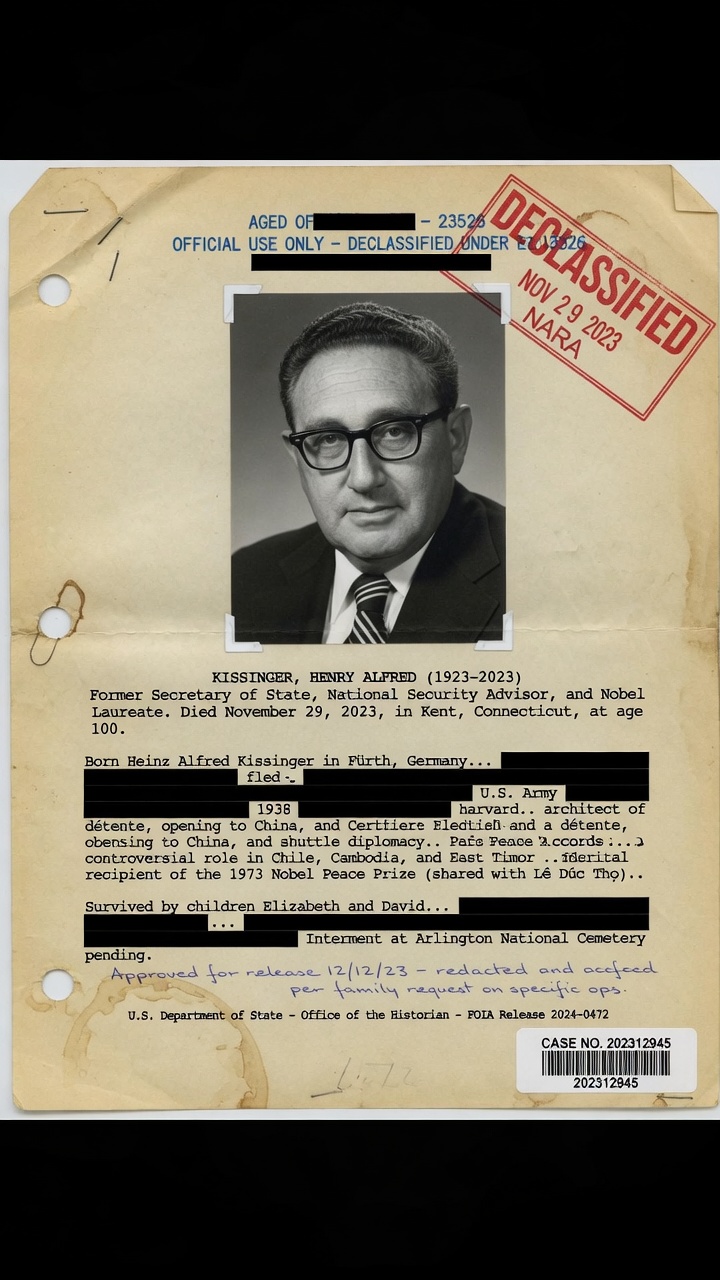
“Henry Kissinger: The Declassified Obituary” is the title of a National Security Archive document collection published on 29 November 2023, following Kissinger’s death. It is an editorial dossier of historical records, not an obituary that a government agency classified and later released.
Correction, 7 October 2026: Unsupported quotations, a claimed 2022 directive and an unverified 4,600-page release have been removed. The sources below identify the actual collection and a route for checking its documents.
In this article
Find the original collection
The National Security Archive’s declassified obituary assembles memoranda, conversation records and telephone transcripts, alongside links to earlier collections. Its commentary covers diplomacy and controversies across several regions. The commentary and each underlying government record should be read as distinct sources.
The Archive describes more than 30,000 pages of telephone transcripts and explains its efforts to recover and obtain access to those official records. That broader transcript corpus should not be confused with the size of the selected obituary dossier.
How to read the records
| Record type | Useful question |
|---|---|
| Policy memorandum | Is this a recommendation, an approved instruction or a later report? |
| Memorandum of conversation | Who attended, who recorded it and what was the context? |
| Telephone transcript | What do the surrounding exchanges change about a quoted sentence? |
| Contingency plan | Is there separate evidence that the option was carried out? |
A document-level example
FRUS Volume XXI, document 347 identifies a Kissinger memorandum to Nixon dated 11 September 1973 at 5 p.m. Its source note locates the original record in the Nixon Presidential Materials. It contains preliminary reporting on Chile’s coup; its existence does not make every contemporaneous assertion definitive.
For the broader chronology, see our guide to Chile’s coup and declassified records. Use the original record’s date and identifier for a quotation, rather than describing an entire archive as newly released.
Assessing a legacy responsibly
A broad judgement about Kissinger’s influence needs more than a selected quotation. Compare actions, stated intentions, contemporary objections and later outcomes. Keep a documented statement distinct from an interpretation of its significance. Where a source cannot be identified, omit the quotation rather than reconstructing plausible wording.
This source guide provides a starting point for that work and keeps the collection’s publication date explicit.