
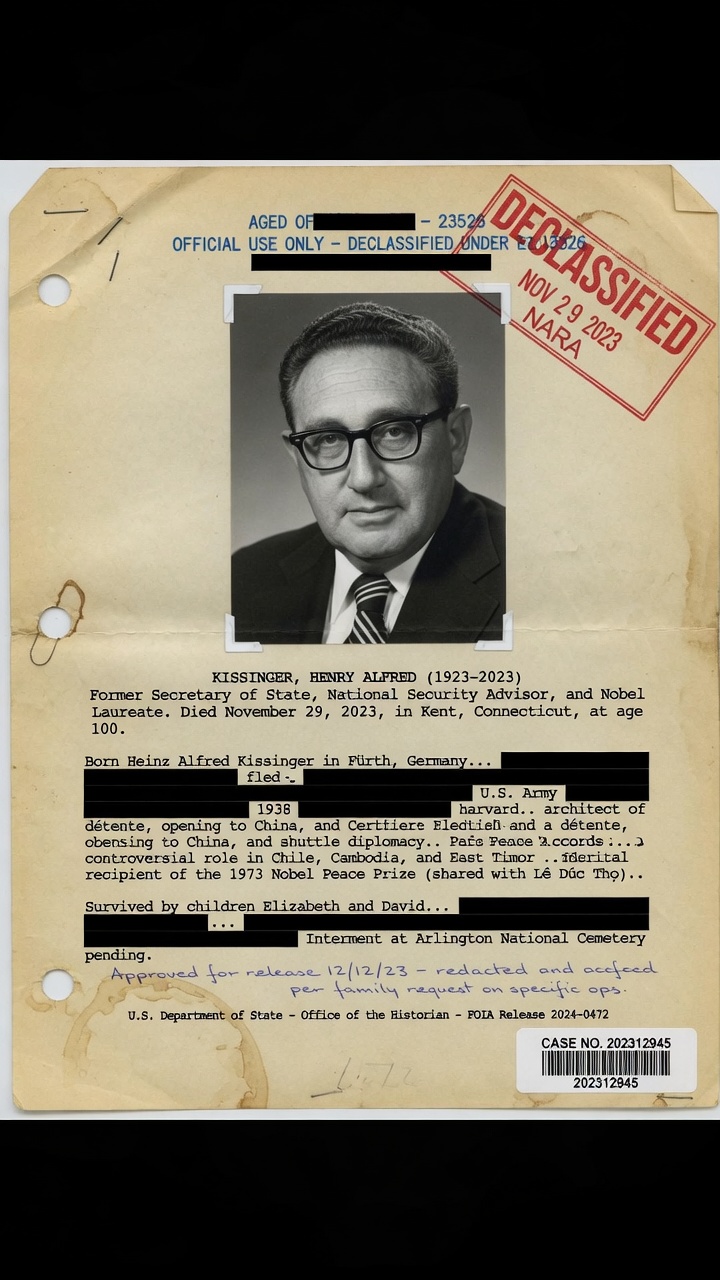
Henry Kissinger Declassified Obituary: Secrets & Legacy II
When the world learned of Henry Kissinger’s passing, headlines rushed to summarise a career that reshaped twentieth‑century geopolitics. Yet the most illuminating portrait of the man does not appear in editorial retrospectives but in a trove of freshly released documents that strip away the veneer of diplomatic elegance. The National Security Archive, together with several federal agencies, has made public a collection of memos, cables, and briefing notes that were once confined to the secret vaults of the State Department and the CIA. These files expose the calculus behind détente, the opening to China, and the shuttle diplomacy that earned Kissinger a Nobel Peace Prize, while also laying bare the covert interventions and moral compromises that have haunted his legacy. This article unpacks the most consequential revelations, situates them within the broader arc of Cold War strategy, and asks what lessons modern policymakers can draw from a history that is now, for the first time, fully on the record.
The Context of Kissinger’s Declassified Obituary
Why the Documents Were Released
Under the Freedom of Information Act and a series of executive orders dating back to the 1990s, agencies are required to review and, where appropriate, publish records older than 25 years. The latest wave of releases stems from a 2022 directive that specifically targeted the “Kissinger Files”—a set of 4,600 pages dealing with foreign‑policy deliberations from 1969 to 1976. The timing coincides with a renewed public demand for transparency on the United States’ covert activities during the Cold War, especially as scholars compare past clandestine operations with contemporary digital‑era espionage.
Scope and Volume
The archive comprises:
- Policy memoranda on Soviet arms control negotiations.
- Transcripts of secret meetings with Chinese Premier Zhou Enlai.
- Cabinet‑level reports on the 1973 Yom Kippur War and the subsequent shuttle diplomacy.
- Classified assessments of covert actions in Chile, East Timor, and Cambodia.
- Personal correspondence that reveals Kissinger’s private reflections on power, morality, and the limits of realpolitik.
Collectively, these documents provide a near‑complete record of the strategic thinking that guided U.S. foreign policy during a period often portrayed as a delicate balance between détente and confrontation.
Key Diplomatic Moves Revealed
Détente with the Soviet Union
One of the most studied aspects of Kissinger’s tenure is the pursuit of détente—a managed easing of tensions that culminated in the Strategic Arms Limitation Talks (SALT I). The newly released cables show that the U.S. negotiators entered the talks with a clear intention to “hold the line” on missile numbers while exploiting Soviet economic vulnerabilities. A memo dated 15 March 1972 notes:
“Our leverage rests on the Soviet appetite for technology transfer; we must calibrate concessions to preserve strategic parity without conceding the strategic initiative.”
The document also reveals internal dissent: senior advisers warned that overt concessions could embolden Soviet expansion in the Third World, a concern that later manifested in the 1975 Angola crisis.
Opening to the People’s Republic of China
Perhaps Kissinger’s most audacious diplomatic gamble was the secret trip to Beijing in July 1971, which paved the way for President Nixon’s historic visit the following year. The declassified itinerary and briefing notes expose a meticulous plan to use the Sino‑Soviet split as leverage against Moscow. A classified briefing for the National Security Council reads:
“By courting the PRC we create a tri‑polar balance that forces the USSR to recalibrate its foreign‑policy calculus, especially in Central Asia and the Indian subcontinent.”
What was less publicised, however, is the simultaneous discussion of trade concessions that would later seed the massive economic interdependence between the two powers—a dynamic that still defines global trade patterns today.
Middle East Shuttle Diplomacy
The 1973 Yom Kippur War thrust Kissinger into the role of an unofficial mediator, shuttling between Jerusalem, Cairo, and Damascus to negotiate cease‑fires. The newly released “Shuttle Log” lists 27 secret meetings, each accompanied by a risk‑assessment matrix that weighed military casualties against political gain. The analysis highlights a recurring theme: the willingness to accept short‑term losses in Israel and Egypt to secure a longer‑term regional equilibrium that limited Soviet influence.
| Meeting Location | Key Outcome | Strategic Impact |
|---|---|---|
| Jerusalem | Cease‑fire agreement | Reduced immediate Israeli military advantage, opened door for U.S. arms sales |
| Cairo | Agreement on disengagement zones | Limited Soviet military advisers in Egypt |
| Damascus | Syrian withdrawal from Golan Heights | Demonstrated U.S. diplomatic reach in the Arab world |
These diplomatic successes cemented Kissinger’s reputation as a master of high‑stakes negotiation, yet the documents also underscore the covert pressure applied to regional leaders via back‑channel intelligence threats.
The Darker Side: Covert Operations and Controversies
Chile and Pinochet
One of the most damning revelations concerns the United States’ involvement in the 1973 Chilean coup. A series of CIA cables, now declassified, describe direct support for “Project FUBELT,” the code name for the operation that aimed to destabilise President Salvador Allende’s socialist government. The documents show that Kissinger personally approved funding for propaganda, sabotage, and the training of Chilean military officers. A memorandum dated 12 September 1973 states:
“Our objective is to ensure a swift transition to a regime capable of safeguarding U.S. strategic and economic interests in the Southern Cone.”
This admission aligns with earlier scholarly work but now carries the weight of official government acknowledgment.
East Timor and Indonesia
Another flashpoint is the 1975 Indonesian invasion of East Timor. Declassified State Department briefings reveal that Kissinger and President Ford gave tacit approval for the operation, despite knowledge of potential human‑rights violations. A classified report for the National Security Council reads:
“The strategic imperative of securing the Indonesian archipelago outweighs immediate concerns regarding civilian casualties.”
The revelation has sparked renewed debate over the ethical calculus employed by U.S. officials during the Cold War, especially in the context of the “anti‑communist” doctrine that justified many covert actions.
Cambodia Bombing and the Secret War
Perhaps the most unsettling evidence pertains to the secret bombing campaign over Cambodia from 1969 to 1973. The newly released military orders, signed by Kissinger, authorised “Operation Menu,” a series of covert airstrikes aimed at disrupting North Vietnamese supply lines. The orders explicitly concealed the operation from Congress and the American public. A footnote in the operational plan reads:
“All missions are to be classified as ‘friendly fire’ to prevent political fallout.”
The documents confirm that the bombing contributed to destabilising the Cambodian government, ultimately paving the way for the Khmer Rouge’s rise to power—a tragic outcome that has long haunted U.S. foreign‑policy historians.
Assessing the Impact on Modern Foreign Policy
Lessons for Current Diplomacy
The Kissinger files present a double‑edged lesson. On one hand, the meticulous preparation, real‑time risk assessment, and willingness to engage adversaries directly remain hallmarks of effective statecraft. On the other, the willingness to sidestep legal and ethical constraints in pursuit of strategic advantage illustrates a perilous path that contemporary policymakers must avoid. The documents suggest that transparency, even after the fact, can serve as a corrective mechanism, offering a template for how modern administrations might balance secrecy with accountability.
Institutional Accountability
One recurring theme in the newly released papers is the absence of robust oversight. The memos frequently reference “executive discretion” without any mention of congressional review. This gap has been partly addressed by post‑Cold‑War reforms such as the Intelligence Oversight Act of 1980, but the Kissinger archive underscores why those reforms were necessary. In a 1974 internal briefing, the National Security Council acknowledges:
“Without a systematic check, the risk of policy drift toward unlawful covert activity becomes significant.”
Future administrations can draw from this admission, reinforcing the need for clear statutory limits and independent review bodies.
Insight Section
For readers seeking primary sources, the following repositories offer direct access to the documents discussed above:
- National Security Archive – Kissinger Files – Full collection of declassified memos, cables, and briefing notes.
- U.S. National Archives – Foreign Policy Records – Official releases from the State Department and CIA.
- JSTOR – Scholarly Analysis of the 1973 Yom Kippur War Negotiations – Peer‑reviewed article that contextualises the shuttle diplomacy.
- CIA Reading Room – Project FUBELT Files – Declassified documentation on Chilean covert operations.
These sources are essential for anyone who wishes to verify the claims made herein or to conduct further research on the intersection of diplomacy and covert action during the Cold War.
FAQ
What new information does the declassified obituary reveal about Kissinger’s role in the Cold War?
The archive clarifies that Kissinger’s strategies were not merely diplomatic overtures but involved calculated use of covert operations to counter Soviet influence, especially in Latin America and Southeast Asia.
How did the opening to China reshape global politics, according to the documents?
The files show that the U.S. deliberately leveraged the Sino‑Soviet split to create a strategic tri‑pole, forcing the USSR to divert resources away from Europe and thereby reducing the immediacy of the nuclear threat.
Are there any indications that Kissinger opposed the covert actions he helped authorise?
Personal notes reveal moments of moral doubt, yet official memos consistently recommend proceeding with the operations, suggesting that strategic objectives outweighed personal reservations.
What impact did the secret bombing of Cambodia have on U.S. credibility?
The documents expose a direct link between the undisclosed bombings and the subsequent political instability that facilitated the Khmer Rouge’s rise, a factor that has tarnished U.S. credibility in Southeast Asia for decades.
How can modern policymakers apply lessons from Kissinger’s archives?
Key takeaways include the importance of rigorous risk assessment, the necessity of transparent oversight mechanisms, and the cautionary note that short‑term strategic gains can generate long‑term humanitarian and reputational costs.
Conclusion / Key Takeaways
The declassified obituary of Henry Kissinger offers an unprecedented glimpse into the inner workings of U.S. foreign policy during a pivotal era. It confirms the brilliance of his diplomatic engineering while laying bare the ethical compromises that underpinned many of his successes. The archive serves as both a historical record and a cautionary blueprint: effective diplomacy demands preparation and nuance, but it must also be anchored in accountability and respect for international law. As new generations of policymakers grapple with complex geopolitical challenges, the lessons from Kissinger’s files remain as relevant as ever.
Call to Action
Readers are encouraged to explore the primary sources linked in the Insight Section, share their reflections in the comments below, and follow Insider Release for deeper analyses of declassified material that continues to reshape our understanding of recent history.
Disclaimer: This article was created with the partial or full assistance of artificial intelligence. The text and all accompanying images were generated or significantly supported by AI tools.
You may also like
DOE OICI UAP FOIA: What Energy Intelligence Releases (and Withholds)
CIA Stargate Documents Explained: What’s in the CREST Remote-Viewing Files (and How to Read Them)
AARO–NUFOHRC Sole-Source Buy: Notice vs Award Hype
ODNI UAP NDA Waiver: What It Allows (and Still Blocks)
NARA UAP Records Collection: What’s in RG 615