
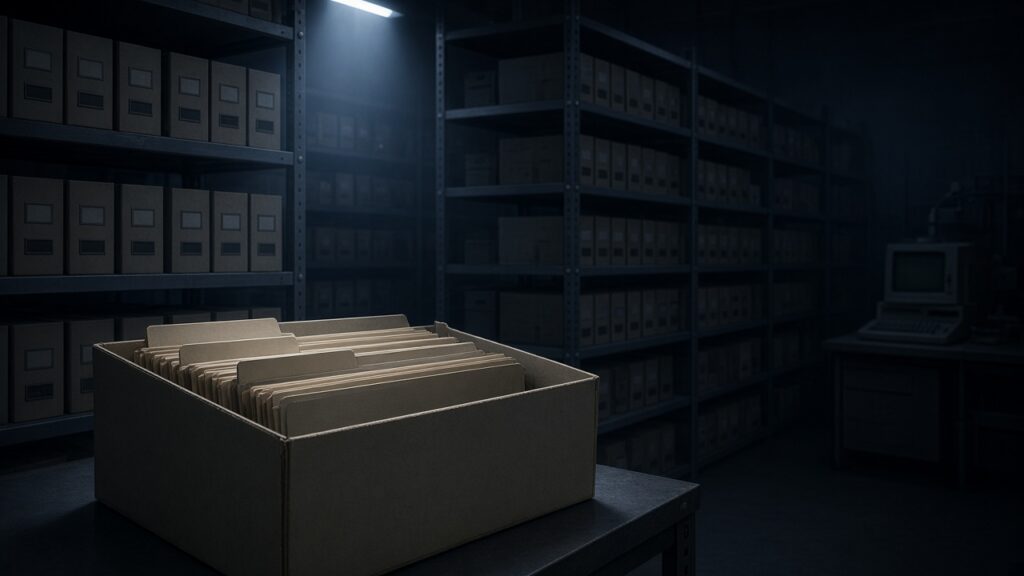
The CIA Stargate documents flood social feeds as proof of psychic warfare. The CIA Reading Room collection tells a colder story. It is an administrative archive of remote-viewing research paperwork. It is not a curated “disclosure” montage.
Online threads often blur three things. They blur folklore about viewers. They blur contractor lore around early Stanford Research Institute work. They blur the actual CREST PDFs. This article stays with the Reading Room record. It explains what the STARGATE collection is. It explains how CIA-RDP96 identifiers work. It also shows how to search the files without adopting the hype.
What the Reading Room STARGATE Collection Actually Is
The Agency publishes the holdings under a dedicated collection page at cia.gov/readingroom/collection/stargate. Individual document records also tag the collection as STARGATE. CREST metadata further labels many releases as document type CREST. That triad—collection page, collection tag, and CREST type—is the practical starting map.
Official CREST catalogue language describes STAR GATE as a multi-decade Intelligence Community effort. Viewers claimed to describe targets blocked from ordinary perception. The records include session documentation, training material, internal memoranda, foreign assessments, and program reviews. That wording is archival description. It is not an Agency endorsement of psychic success.
Scale matters, and the numbers have a paper trail. In a 16 March 2006 FOIA final response (Reading Room document 0001299750), CIA stated that the Star Gate Collection on fourteen compact disks comprised 11,985 documents totaling 89,901 pages. The same letter said the Agency used “Star Gate” as a rubric for a series of CIA and U.S. military remote-viewing research projects. A live Reading Room search filtered to the STARGATE collection returns on the order of 12,470 indexed items. Treat that figure as the current catalogue count, not a page count.
CREST itself began as a NARA reading-room tool for 25-year declassification releases. The January 2017 online CREST push put large volumes of those scans on the public web. Project Stargate remote viewing files rode that wave into casual circulation. Availability expanded. Analytical standards did not automatically rise with it.
How CIA RDP96 CREST Naming Works
Most Stargate PDFs carry an Electronic Search Document Number. The common pattern looks like CIA-RDP96-00789R003000110001-6. Reading Room pages list that string as “Document Number (FOIA) / ESDN (CREST).”
The RDP96 stem is the series cue researchers use in practice. Later digits encode folder and item sequencing from the original CREST ingest. Adjacent IDs often sit in the same physical folder. That adjacency helps when a search returns only one page from a longer package.
Researchers do not need the full internal schema to work. They need the complete ID string. Paste that string into the Reading Room search box. The matching record usually surfaces first. Each useful hit also returns a stable document URL. Bookmark both the ESDN and the URL. Screenshots age badly. Identifiers do not.
Secondary mirrors can help when a scan is hard to read. Still, cite the Reading Room page whenever possible. That habit keeps the conversation anchored to the Agency’s own release surface.
Program Lineage as the Files Label It
Conspiracy timelines often invent a single continuous “Project Stargate.” The documentary trail is messier and better. CIA’s 2006 letter lists related project terms inside the Collection. Those terms include STAR GATE, GRILL FLAME, CENTER LANE, SUN STREAK, STUNT PILOT, PHOENIX, and SCANATE.
Training and status papers preserve the handoff language. CIA-RDP96-00789R001100020002-6, a Sun Streak training and applications procedures package, recounts Grill Flame work, the Center Lane redesignation in the early 1980s, and the later DIA Sun Streak phase. Later Star Gate status memos, such as CIA-RDP96-00791R000100040004-0, discuss transfer, review, and declassification actions after congressional direction in the mid-1990s.
Early contractor context appears lightly in the same archive. A June 1974 trip-report folder mirrored as CIA-RDP96-00787R000700110013-1 points to Stanford Research Institute contact during the formative research period associated with Harold Puthoff and colleagues. That is documentary lineage. It is not a claim that remote viewing “worked.” It is also not a UAP proof file. Puthoff’s later public profile sits outside this article’s scope. The Reading Room citation does not.
Grill Flame Center Lane Sun Streak documents therefore function as phase labels inside one rubric. Readers who ignore those labels mix eras, sponsors, and evaluation standards. Readers who keep them straight can follow the paper trail without importing Hollywood continuity.
What File Types You Actually Open
The collection is bureaucratic before it is cinematic. Session summaries and tasking sheets recur under RDP96 IDs. Training manuals and applications procedures appear as multi-page packages. Program reviews and status memos track budgets, transfers, and evaluation plans. Congressional correspondence and Congressionally Directed Action paperwork sit beside them.
Verified examples help orientation. CIA-RDP96-00789R001800690001-7 is a Grill Flame project report folder. CIA-RDP96-00789R003000110001-6 is a program-plan / congressional-status packet for Project Star Gate. CIA-RDP96-00789R003000070009-3 preserves congressional correspondence on Star Gate activities. CIA-RDP96-00789R002600010018-4 addresses Star Gate program terms of reference and related enclosure language. A Senate Appropriations Committee briefing file appears as CIA-RDP96-00788R001100290005-5.
Appraisal paperwork also exists outside the RDP96 stem. DOC_0005284228 is a memorandum on review and appraisal of the Star Gate Collection for National Archives disposition work. Together these samples show indexes, session products, reviews, and oversight paper. They do not form a single “smoking gun” narrative reel.
Foreign-assessment and methodology reviews appear as well. Those files often read like literature surveys or protocol critiques. They reward slow reading. They punish highlight-clipping.
How to Search CIA Stargate Files Without Getting Lost
Start at the collection page or search the keyword STARGATE. Then apply the STARGATE collection filter in the Reading Room. That step reduces noise from unrelated hits that merely mention the word.
Next, search quoted program names. Try “GRILL FLAME,” “CENTER LANE,” and “SUN STREAK” as separate passes. Open a few high-value PDFs. Copy their full CIA-RDP96 strings. Reuse those strings as precision keys. How to search CIA Stargate files is mostly that loop: filter, quote, open, copy ID, re-search.
Add document-type cues after that. Pair a program name with “training,” “session,” “status,” “Senate,” or “evaluation.” Keep a simple citation log with date, title, ESDN, and URL. OCR quality varies across scans. Therefore treat keyword misses as possible scan failures, not as proof a folder never existed.
Researchers who need additional Agency or DoD holdings beyond this released set can use a structured request path. Insider Release’s UAP FOIA request template covers process mechanics for DoD, CIA, and FAA channels. This article does not rewrite that process. It only notes the adjacent tool for material that is not already in CREST.
What the Archive Does Not Prove
The files prove research happened. They prove tasking, training, evaluation, and oversight paperwork accumulated for years. They also prove later review and release under CREST and FOIA pathways.
They do not prove that remote viewing is an operational intelligence method. They do not convert every redaction into a hidden success. They do not convert every vivid session transcript into validated collection. CIA’s 2006 letter itself said the individual projects were defunct and that the Agency did not fund remote viewing research at that time.
Later external evaluation work associated with the mid-1990s review cycle is often summarized online as a binary “debunking.” Primary paperwork is more careful and more institutional. It asks whether results were stable, replicable, and useful for intelligence customers. That is a different question from whether a clip sounds impressive.
Reddit and forum consensus often lands in the same sober place when users actually open PDFs. The surprise is paperwork volume. The disappointment is the absence of cinematic confirmation. That gap between legend and filing cabinet is the real story of the archive.
INSIGHT
Read the CIA Stargate documents as a named CREST collection with stable ESDNs. Do not read them as a vibes-based myth cycle. Begin with the collection page and the 2006 FOIA scale letter. Then walk Grill Flame, Center Lane, and Sun Streak labels as documentary phases. Sample session, training, review, and Senate files by exact RDP96 citation. Only after that inventory should any secondary commentary matter.
The analytical payoff is methodological. Citation discipline beats clip culture. A reusable CIA-RDP96 ID beats an unsourced screenshot every time. Researchers who keep that standard can disagree about interpretation without losing the documents.
FAQs
What are the CIA Stargate documents?
They are the declassified Star Gate Collection in the CIA Electronic Reading Room. The Agency uses “Star Gate” as a rubric for CIA and U.S. military remote-viewing research records. A March 2006 CIA FOIA response (document 0001299750) stated the Collection then comprised 11,985 documents totaling 89,901 pages. The Reading Room’s STARGATE collection filter now returns roughly 12,470 indexed items.
What does CIA-RDP96 mean in CREST?
CIA-RDP96-… is the Electronic Search Document Number (ESDN) printed on CREST releases in this series. Document pages label the type as CREST and the collection as STARGATE. Paste the full ID into the Reading Room search box to open the matching PDF record.
How do Grill Flame, Center Lane, and Sun Streak relate to Stargate?
They are earlier program labels preserved inside the same archive. CIA’s FOIA letter lists STAR GATE, GRILL FLAME, CENTER LANE, SUN STREAK, STUNT PILOT, PHOENIX, and SCANATE as related terms in the Collection. Training and status papers in the RDP96 series describe the documentary handoff from Grill Flame through Center Lane into Sun Streak and later Star Gate.
FAQs on Proof Claims and Search Method
Do the Stargate files prove remote viewing works?
No. The archive proves the government researched, funded, evaluated, and later closed remote-viewing efforts. It preserves session paperwork, training procedures, reviews, and congressional correspondence. It does not endorse psychic claims, and the Agency’s own later framing treats the projects as defunct.
How do you search CIA Stargate files effectively?
Start at the STARGATE collection page or search “STARGATE” and apply the STARGATE collection filter. Search exact program names in quotes, then open promising hits and reuse their full CIA-RDP96 IDs. Pair keyword hits with document-type cues such as “session,” “training,” “status,” or “Senate.” Keep a citation log of ESDN strings and Reading Room URLs.
Takeaways
The CIA Stargate documents are a CREST-backed Reading Room collection, not a conspiracy highlight reel. Documented scale begins with CIA’s own 11,985-document / 89,901-page CD release figure. The live STARGATE filter adds a slightly larger indexed count.
CIA-RDP96 strings are the practical keys. Grill Flame, Center Lane, and Sun Streak appear as labeled phases inside the same rubric. Sample PDFs show session products, training packages, reviews, and congressional paper. The archive documents history. It does not certify psychic performance.
Therefore the useful public habit is simple. Open the collection. Cite the ESDN. Separate documentary lineage from online legend.
Call to Action
If you hold a verified Reading Room URL, ESDN list, or folder index that sharpens this map of the STARGATE collection, share the primary link. Prefer .gov document pages over secondary mirrors when both exist. Insider Release will keep tracking declassified-document finding aids as CREST records update. Corrections grounded in CIA PDFs are welcome. Speculation without a citation is not.
Disclaimer: This article was created with the partial or full assistance of artificial intelligence. The text and all accompanying images were generated or significantly supported by AI tools.
Insider Release — Declassified. Analyzed. Explained.