
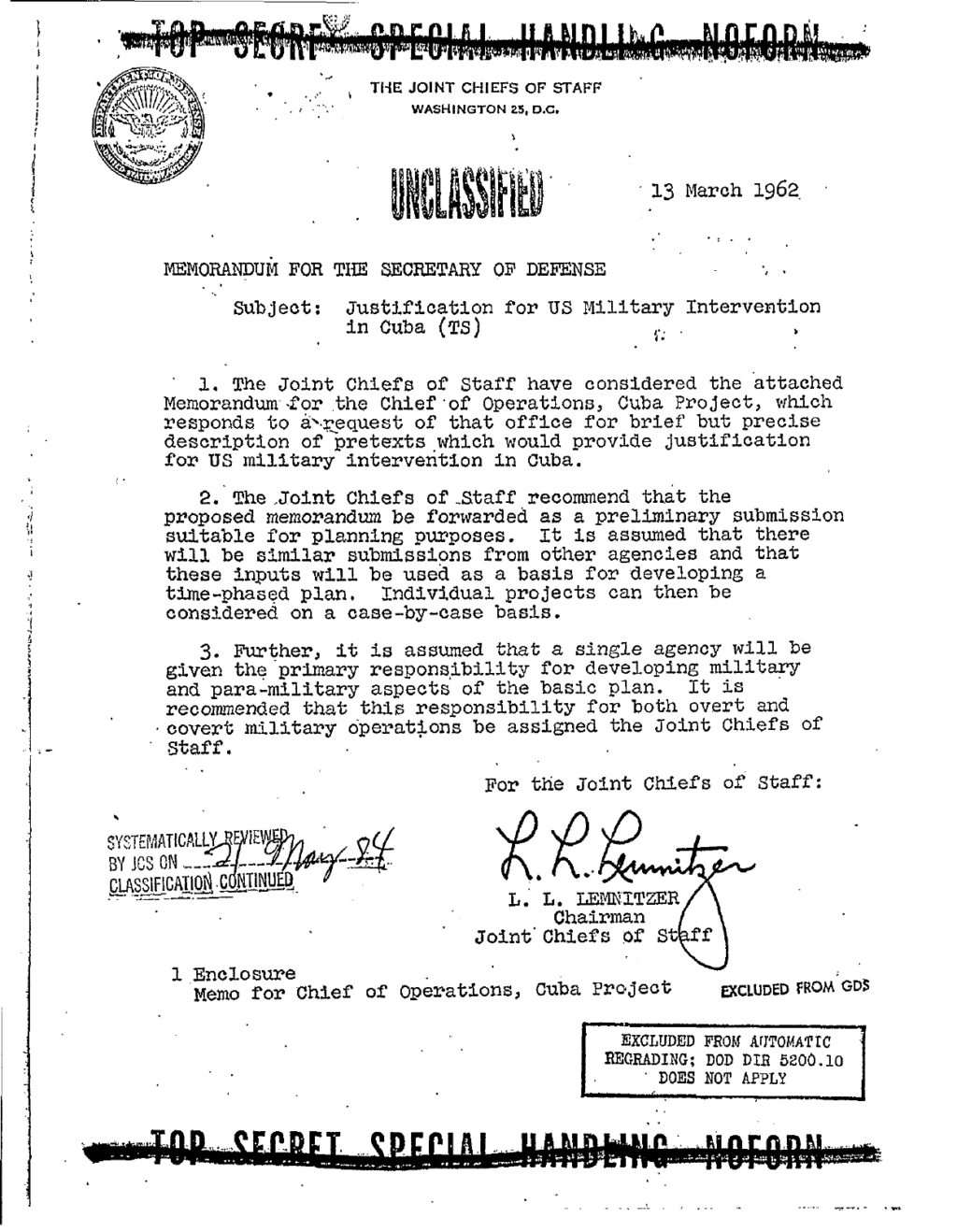
Operation Northwoods documents record a real 1962 Joint Chiefs proposal to manufacture pretexts for U.S. military intervention in Cuba. They establish what senior military leaders put forward. They do not establish that those proposed attacks took place. You can read the declassified memorandum online, without relying on screenshots or a retelling.
The useful question is what each part of the file proves. A signature, a recommendation and an execution order carry different meanings. Start with the original record, then check the surrounding decisions.
In this article
Where to read the Operation Northwoods documents
Two collections provide different views of the paperwork. The National Security Archive’s 15-page PDF is the convenient starting point. Its opening page is the March 13, 1962 memorandum to Secretary of Defense Robert McNamara, signed by Joint Chiefs Chairman Lyman Lemnitzer.
For a wider archival trail, open the National Archives Northwoods case file. NARA identifies the record as 202-10002-10104, from JCS Central Files 1962, Box 29. The case number is 3360 (7 Feb 62). These identifiers help distinguish a government record from an excerpt circulating without context.
The NARA release table lists 197 pages in its metadata. The linked PDF contains 212 scanned pages. Those are different counts, so cite the record number and the specific page you use rather than assuming every copy has identical pagination.
Download the file you intend to cite. Then record both the PDF page number and any number printed on the document. Cover sheets, archival forms and attachments can shift the two sequences.
What the 1962 proposal actually says
The memorandum sought pretexts for intervention and presented its suggestions as preliminary planning. Its annex included staged incidents around Guantanamo, destruction of a ship blamed on Cuba, violence directed at Cuban refugees, and a fabricated civilian-airliner shootdown. Some scenarios involved simulation; others contemplated real harm. Describing the entire package as a harmless exercise would therefore misrepresent it.
However, the opening memorandum recommends further planning and case-by-case consideration. That distinction matters: approval within the Joint Chiefs process is not the same as presidential authorization to carry out an attack. The Archive’s document description also identifies Northwoods as proposed pretexts within the broader Cuba operation.
The document is disturbing on its own terms. There is no need to attach an unsupported modern allegation to make it significant.
Did Kennedy approve Operation Northwoods?
Read the contemporaneous decision record alongside the proposal. The State Department publishes Document 314, Guidelines for Operation Mongoose, in its Foreign Relations of the United States series. Its source note describes a March 16, 1962 discussion with President John F. Kennedy.
According to that note, Kennedy expressed skepticism that circumstances would justify overt military action. It also records that the meeting conveyed no approval to use American forces, although contingency planning would continue.
This is relevant evidence about the limits on intervention. It is not a line-by-line presidential response to every Northwoods suggestion. Consequently, a careful account should identify which decision a source records, rather than present a related meeting note as a signed rejection letter for the entire annex.
The Operation Northwoods documents discussed here document a proposal. They provide no basis for saying military units carried out its staged attacks. A claim of implementation would require additional evidence: an authorization, an operational record or another trace connecting a specific action to the plan.
How Northwoods fits into Operation Mongoose
Northwoods and Mongoose should not be treated as interchangeable names. The Office of the Historian’s account of the Bay of Pigs and Operation Mongoose explains that the Kennedy administration adopted a new covert Cuba program after the failed 1961 invasion.
Mongoose combined political, psychological, intelligence and sabotage efforts aimed at removing Fidel Castro’s government. The CIA and Defense Department participated under Edward Lansdale’s direction. The State Department notes that some planned Mongoose activities were deployed during 1962, while the contemplated military intervention did not occur.
Therefore, evidence that Mongoose involved real covert activity does not prove that anyone implemented the Northwoods annex. Keep the program, the individual proposal and the particular action separate. Otherwise, a true statement about one becomes a misleading statement about another.
When were the Operation Northwoods documents released?
The public history of the records has several stages. The National Security Archive explains that the memorandum reached the public through the Kennedy Assassination Records Review Board’s work in the 1990s. Author James Bamford supplied the Archive with a copy, which it posted online in 2001.
The Archive’s April 30, 2001 posting remains accessible. NARA’s broader case file also appears in its 2017–2018 additional-release records. These later access points should not be described as proof that Northwoods was first uncovered in 2026.
A release date tells you when a particular version became available. It does not, by itself, tell you when the underlying plan was written, adopted or carried out. Preserve those dates separately in your notes.
A practical checklist for reading the file
- Establish provenance. Save the archive URL, record number and document date before quoting a passage.
- Read the opening memorandum. Identify its sender, recipient and requested decision. Do this before reading the most dramatic annex.
- Separate document layers. A cover sheet, draft attachment and decision note can describe different stages of the same process.
- Check the verbs. Do not substitute proposed, recommended, approved and executed for one another.
- Follow the claim. If a writer says an incident happened, ask for evidence of that incident rather than another copy of the proposal.
For related archive research, see our CIA Reading Room search guide. If a needed record is absent, our agency-specific FOIA request guide explains how to frame a records request. Adapt the agency and subject to the Cuba file; do not send a UAP template unchanged.
FAQs
Are the Operation Northwoods documents real?
Yes. NARA provides a Northwoods case file with a record identifier and archival provenance. The March 1962 memorandum is also available through the National Security Archive. Authentic paperwork establishes the proposal’s existence; it does not validate every later claim made about it.
Where can I download the Operation Northwoods PDF?
Use the 15-page scan linked above for the central memorandum and attachments. Use NARA’s larger case file for the surrounding paperwork. Both links lead directly to PDFs, and neither requires a paid archive subscription.
Does Northwoods prove that a later attack was staged?
No. Similarity between a proposed scenario and a later event is not a documentary connection. Such a claim needs evidence specific to that event. The historical file cannot supply missing evidence for an unrelated allegation.
Is this a new declassification?
No. The Archive’s online posting dates to 2001, and NARA also supplies the broader file through its additional-release collection. A new social-media discussion does not make an old record newly declassified.
Source note
This article links to the Joint Chiefs memorandum, NARA’s case file and release metadata, and the State Department’s published Cuba records. The reading checklist and distinctions between evidence and inference are Insider Release’s analysis. Consult the linked scans before reusing an excerpt.
Have a relevant authorization or implementation record? Send its archive identifier through our contact page so we can check the claim against the document.