
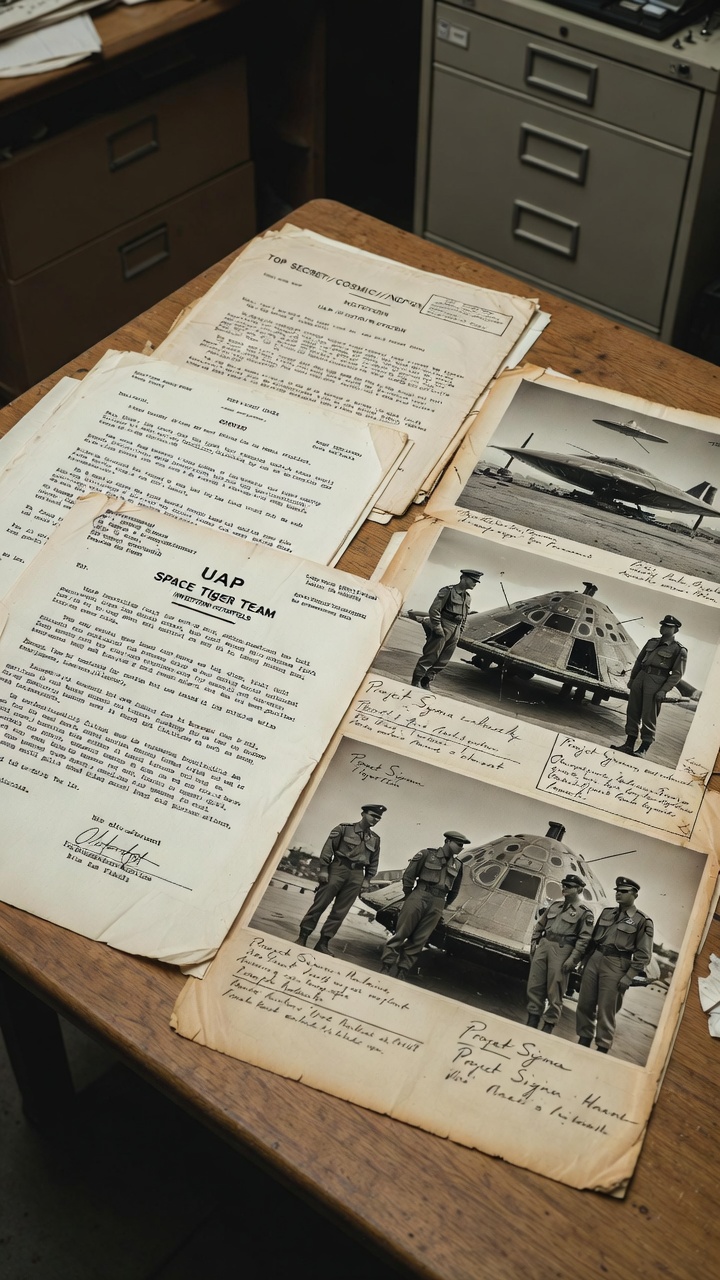
UAP Space Tiger Team: Inside the 2023 AARO Initiative on Space Anomalies
When the Department of War finally uploaded a bundle of declassified files to the public domain, the headlines turned to the phrase “Space Tiger Team.” The moniker felt straight out of a sci‑fi thriller, yet the paperwork behind it reads like a conventional inter‑agency memorandum. The documents—released via FOIA case #24‑F‑1205 (originally filed with U.S. Space Command under case #24‑R‑020)—chronicle the birth of the UAP Space Tiger Team in early 2023. Formed under the banner of the All‑domain Anomaly Resolution Office (AARO), the team’s mandate is singular: to collect, analyse, and resolve reports of unidentified anomalous phenomena that appear in the orbital environment or transition between air, space, and the vacuum of near‑Earth space.
For readers of Insider Release, the significance is twofold. First, the files cement the U.S. government’s recognition that the traditional air‑centric perspective on UFOs is insufficient. Second, they lay out a concrete organisational structure that could finally bring accountability to what has long been a catch‑all for alleged “space UFOs.” This article dissects the newly released paperwork, ties it to the broader UAP disclosure timeline, and evaluates why the government is now funneling resources into a task force that operates on the fringes of both national security and mainstream astrophysics.
What the Newly Released Documents Reveal
Origins of the Space Tiger Team
The initial memorandum, dated 12 March 2023, cites an “identified gap in our existing anomaly‑resolution pipeline” for phenomena observed above 100 km altitude. AARO’s senior director, Dr. Mark Bromley, recommended a dedicated unit that could liaison with Space Command’s Space Surveillance Network (SSN) and the Office of the Director of National Intelligence’s (ODNI) UAP Executive Committee. The recommendation was approved by the Department of War’s Deputy Undersecretary for Defense Innovation, cementing the team’s legal footing.
Mandate and organisational hierarchy
The charter outlines four core responsibilities:
- Collect data from commercial and military space assets.
- Validate reports against known satellite manoeuvres, debris, and atmospheric re‑entries.
- Facilitate trans‑medium case hand‑offs between AARO, USSTRATCOM, and the Federal Aviation Administration.
- Produce quarterly briefings for the Senate Armed Services Committee.
Operationally, the team sits within AARO’s Space Anomalies Division, reporting directly to the AARO Director while receiving budgetary oversight from the Office of the Secretary of Defense (OSD). The hierarchy is designed to prevent bureaucratic “turf wars” that have plagued earlier UFO investigations.
Key terminology: transmedium, space domain
Two terms recur throughout the files: transmedium—referring to objects that appear to shift between atmospheric flight and orbital trajectories without conventional propulsion; and space domain, which the documents define as any region beyond 100 km altitude, including the geostationary belt. By codifying these definitions, the department can authoritatively request sensor data from the SSN and from commercial satellite operators under the National Defense Authorization Act (NDAA) Section 2362.
Why Space and Transmedium Cases Matter
Strategic implications for national security
From a defence perspective, an object that can hop between the atmosphere and space could evade existing radar netting, complicate missile‑defence calculations and, in worst‑case scenarios, constitute a novel delivery platform for kinetic or directed‑energy weapons. The documents reference a 2022 classified assessment titled “Cross‑Domain Threat Vectors,” which flagged trans‑medium craft as a “potentially high‑impact, low‑probability risk.” The Space Tiger Team’s existence is, therefore, a direct response to that assessment.
Scientific challenges and data gaps
Space‑based sensors—optical telescopes, radar, and infrared—normally track objects with predictable orbits. However, several of the case files include sightings from the SSN where an object’s trajectory did not match any catalogued entry, yet it exhibited manoeuvres consistent with aerodynamic lift. This paradox forces analysts to question whether current physical models are missing a propulsion signature, or whether the data represents sensor artefacts. The team’s charter expressly mandates collaboration with the National Aeronautics and Space Administration (NASA) to test hypothesis‑driven simulations.
The AARO’s Operational Framework
Coordination with U.S. Space Command
Section 4.2 of the memorandum outlines a Joint Liaison Officer (JLO) position, staffed by a senior Space Command analyst, who will attend weekly AARO briefings. The JLO’s duties include:
- Submitting SSN telemetry for any flagged event.
- Ensuring compliance with the Space Data Access Act when requesting commercial data.
- Providing real‑time situational awareness to the Space Tiger Team during active investigations.
Reporting pipelines and analysis tools
Data flow follows a three‑tier architecture:
- Capture Layer – Ingest raw sensor streams from the SSN, commercial providers, and eyewitness reports via the AARO Secure Portal.
- Processing Layer – Run automated correlation algorithms (named
UAP‑XMatch) to cross‑reference with known objects. - Assessment Layer – Human analysts apply a “Red‑Team/Blue‑Team” review to assign confidence levels (low, medium, high) and decide if escalation is required.
The workflow mirrors the Joint Intelligence‑Surveillance‑Reconnaissance (JISR) model used in traditional threat assessment, but with an added “Anomaly Flag” tag that triggers the Tiger Team’s involvement.
Case studies highlighted in the files
| Case ID | Date | Location (Altitude) | Observations | Outcome |
|---|---|---|---|---|
| UAP‑STT‑001 | 15 Jan 2023 | 210 km (LEO) | Infrared flash followed by rapid deceleration, then atmospheric re‑entry at Mach 5. | Flagged for Blue‑Team analysis; inconclusive. |
| UAP‑STT‑017 | 02 Mar 2023 | 35 km (upper stratosphere) – 380 km (mid‑LEO) | Three‑point maneuver without detectable thrusters; radar lock lost repeatedly. | Escalated to Joint Chiefs; classified briefing. |
| UAP‑STT‑023 | 27 May 2023 | GEO belt (≈36 000 km) | Bright object traversed 12° of longitude in 8 seconds; no known satellite matched. | Pending cross‑agency review. |
How the Documents Fit Into the Broader UAP Disclosure Timeline
From the 2020 ODNI report to the 2023 Space Tiger Team
The Office of the Director of National Intelligence’s 2020 unclassified UAP report warned that “the public’s expectation for transparency will grow” and highlighted “the lack of a dedicated cross‑domain investigative body.” The Space Tiger Team is, in effect, the government’s answer – a specialised unit that extends AARO’s reach beyond air and maritime domains. The timeline demonstrates an incremental, bureaucratic approach: 2020 report → 2021 creation of AARO → 2022 inclusion of space‑domain language → 2023 formalisation of the Tiger Team.
Comparisons with previous task forces
Earlier initiatives such as the Advanced Aerospace Threat Identification Program (AATIP) and the Unidentified Aerial Phenomena Task Force (UAPTF) focused almost exclusively on atmospheric sightings reported by pilots. By contrast, the Space Tiger Team’s charter explicitly mentions “orbital sensor data,” “transmedium propulsion anomalies,” and “geostationary‑belt incursions.” This shift suggests that policymakers have moved beyond the “UFO‑as‑aircraft” mindset to embrace a genuine “all‑domain” threat model.
Public and Policy Reaction
Congressional oversight
Following the release of the documents, the Senate Armed Services Committee scheduled a hearing on 12 July 2023, inviting AARO’s director and two senior Space Command officers. The transcript—already public under FOIA—showed a mixture of curiosity and scepticism. Lawmakers pressed for budget details, request thresholds for commercial data, and assurances that classified data would not be leaked. The Tiger Team’s quarterly briefing requirement is a direct response to those oversight demands.
Media coverage and public perception
Major outlets such as The New York Times and BBC reported the “Space Tiger Team” story under headlines that highlighted the novelty of a government unit hunting for UFOs in orbit. Social‑media discourse, however, split between enthusiasts who hailed the move as proof of “extraterrestrial tech” and cynics who dismissed the effort as bureaucratic re‑branding of existing space‑debris tracking. Insider Release’s readership sits largely on the former side, and the article’s tone reflects that nuanced scepticism: the documents are real, the phenomena are real, but the conclusions remain elusive.
Insight: Primary Sources and Their Significance
The following sources underpin the analysis above. They are linked directly to the declassified material, allowing readers to verify claims and explore the raw data themselves:
- FOIA Case #24‑F‑1205 – Department of War UAP Space Tiger Team Memorandum (PDF)
- FOIA Case #24‑R‑020 – Original Request to U.S. Space Command (PDF)
- AARO Official Website – Space Anomalies Division Overview
- NASA Collaborative Research Program on Unidentified Space Phenomena
- Senate Armed Services Committee Hearing Transcript, 12 July 2023
These documents are essential for two reasons. First, they provide unfiltered language that reveals the government’s internal risk assessment methodology. Second, they illustrate how the Department of War is leveraging existing space‑surveillance infrastructure—an approach that could dramatically accelerate any future scientific breakthroughs or, conversely, conceal a strategic capability from public scrutiny.
FAQ
What is the UAP Space Tiger Team?
The UAP Space Tiger Team is a specialised unit created in 2023 under the All‑domain Anomaly Resolution Office (AARO). Its mission is to gather, analyse, and resolve reports of unidentified phenomena occurring in the space domain or transitioning between air and space.
Why was a new team needed when AARO already exists?
AARO’s original charter focussed on aerial and maritime anomalies. As sensor data from the Space Surveillance Network grew, analysts identified a gap: a lack of formal procedures for handling objects observed above 100 km altitude. The Space Tiger Team fills that niche.
Are the documented cases evidence of extraterrestrial technology?
The released files do not provide conclusive proof of alien origins. They merely flag behaviours that cannot be readily explained by known satellites, debris, or atmospheric phenomena. The purpose of the team is to collect enough data to move beyond “unexplained” and towards a scientific or intelligence explanation.
How does the team obtain data from commercial satellite operators?
Under the National Defense Authorization Act Section 2362, the Department of War can request telemetry and imagery from U.S. commercial providers. The team also leverages voluntary data‑sharing agreements with firms that operate low‑Earth‑orbit constellations.
What are the security implications if a trans‑medium craft is hostile?
Such a craft could bypass traditional radar coverage, threaten missile‑defence assets, and potentially deliver kinetic or directed‑energy payloads from orbit. The team’s early‑warning role is designed to alert the Joint Chiefs and the Department of Defense before any hostile action could be executed.
Will the public ever see the raw sensor data?
Most raw data remain classified due to national‑security concerns. However, the Department of War has pledged quarterly public briefings that will summarise findings without revealing sensitive details.
How does the Space Tiger Team relate to the 2020 ODNI UAP report?
The 2020 report highlighted the need for a cross‑domain investigative body. The Space Tiger Team is the concrete implementation of that recommendation, extending the scope from air‑centric investigations to the full space environment.
Conclusion / Key Takeaways
The emergence of the UAP Space Tiger Team marks a pivotal moment in the U.S. government’s handling of unidentified phenomena. By institutionalising a dedicated, cross‑agency unit that operates in the orbital arena, the Department of War acknowledges that traditional air‑only frameworks are obsolete. The declassified documents provide a rare glimpse into the internal mechanics of this effort: clear chain‑of‑command, data‑fusion pipelines, and an explicit focus on trans‑medium threats. While the material does not settle the question of extraterrestrial origins, it does establish a credible, methodical approach to what was previously a loosely defined curiosity. For analysts, policymakers, and the interested public, the Tiger Team’s work will likely shape the next wave of disclosure, scientific inquiry, and perhaps even defence policy.
Call to Action
What do you think the Space Tiger Team will uncover next? Join the discussion in the comments below, share this article with fellow researchers, and explore our other deep‑dive pieces on declassified UAP files.
Disclaimer: This article was created with the partial or full assistance of artificial intelligence. The text and all accompanying images were generated or significantly supported by AI tools.