
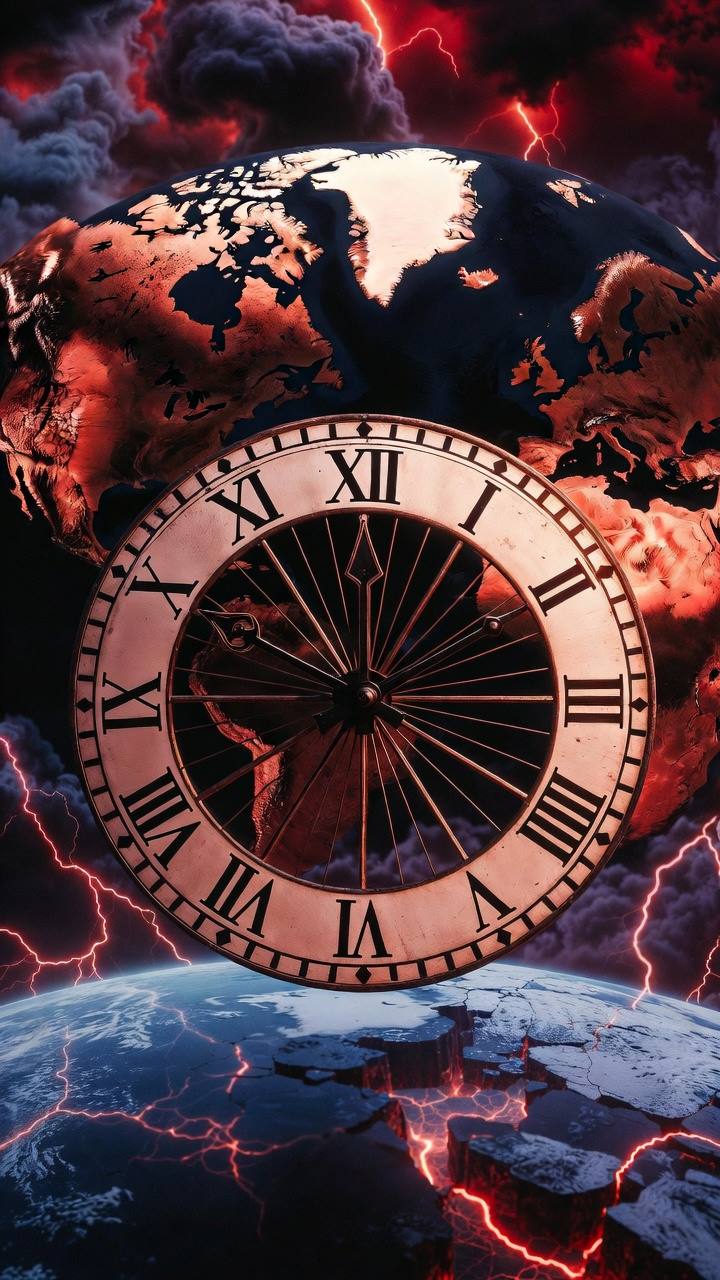
On 27 January 2026, the Bulletin of the Atomic Scientists’ Science and Security Board set the Doomsday Clock at 85 seconds to midnight—the closest setting in the Clock’s history. The previous mark was 89 seconds. The Board’s statement is measured, footnoted, and blunt about cause: failure of leadership among major powers, plus simultaneous pressure from nuclear risk, climate extremes, biological threats (including “mirror life” and AI-assisted bio design), and disruptive technologies—especially military and information uses of AI.This article maps what the Bulletin’s 2026 statement and supporting risk pages actually cite. It is not a panic brief. The Clock is a communication device created in 1947 by scientists who understood nuclear weapons; midnight stands for catastrophic failure across man-made threats, not a literal countdown timer. Reading the primary statement beats recycling the second hand as spectacle.
In this article
What “85 seconds” means on the record
The Board wrote that Russia, China, the United States, and other major countries have become more aggressive, adversarial, and nationalistic; that hard-won global understandings are collapsing into winner-takes-all competition; and that too many leaders have grown complacent or indifferent—sometimes adopting policies that accelerate rather than mitigate existential risks. “Because of this failure of leadership,” the Board set the Clock at 85 seconds to midnight, “the closest it has ever been to catastrophe.”Treat that as the Board’s judgment, published under its own name. It is not a classified intelligence finding and not a prediction of a date. It is an expert-group assessment intended to force public attention onto interlocking risks.Nuclear risks the Board emphasises
Nuclear weapons remain the fastest path to midnight in the Board’s framing. The 2026 nuclear discussion stresses renewed brinkmanship and a crumbling arms-control architecture. Among the themes the Bulletin highlights: nuclear signalling around the war in Ukraine; regional escalation risks involving other nuclear-armed states; rapid arsenal growth and modernisation among major powers; and the approaching end of New START limits without a replacement talks track that matches the moment.The Board also flags U.S. plans for a multilayered “Golden Dome” missile-defense concept that includes space-based interceptors—viewed by Russia and China as destabilising—and concern that historical nuclear test sites are being prepared for possible resumed testing. The through-line is competition over dialogue: without serious strategic-stability talks, miscalculation and accident risk rise even if no leader “wants” nuclear use.Insider Release’s interest here is transparency and governance: when arms-control paper disappears, public accountability for nuclear policy thins with it.Climate as an active instability driver
Climate has been part of the Clock’s calculus since 2007. In the 2026 framing, the Board treats recent record heat, rising CO₂ relative to pre-industrial levels, sea-level rise, and extreme-weather disasters as evidence that policy response still lags scientific reality. Climate is cast not only as a long-horizon hazard but as a present driver of food insecurity, migration, and resource competition that feeds back into nuclear and biological risk.Under Insider Release’s Systemic Risks door (Strategy A: intelligence and transparency lens), the relevant question is less lifestyle commentary and more whether governments publish, preserve, and act on risk assessments with the same seriousness they apply to classified threat streams. The Bulletin’s climate pages are the citation path; partisan campaign slogans are not.Biological threats: mirror life and the AI shortcut
The 2026 assessment elevates biological risk with unusual sharpness. The Board points to laboratory work on “mirror life”—synthetic organisms built from mirror-image molecules that could, in worst-case release scenarios, evade natural biological controls—and warns of existential stakes if such systems were accidentally or deliberately released.Alongside that: AI tools that lower barriers to designing novel pathogens or recreating known ones; persistent state interest in biological weapons amid weakening norms; and degraded public-health capacity and trust in scientific institutions in key countries. The intersection of AI and biology is treated as a force-multiplier for smaller actors. The Board calls for multilateral agreements on mirror-life synthesis and stricter controls on AI-assisted biological design—while noting how little progress is visible.Label carefully: these are Board risk judgments and policy asks, not proof that a mirror-life catastrophe is underway.AI as accelerant, not a standalone apocalypse story
In the 2026 statement, artificial intelligence appears mainly as an accelerant of other catastrophic risks. Themes include integration of AI into nuclear command, control, and targeting concepts; erosion of prior AI-safety policy commitments in major capitals; escalation pathways through misidentification or brittle automated assessment; and AI-supercharged disinformation that pollutes the information environment needed for coherent response to nuclear, climate, and biological threats.The Board does not call for halting AI development. It calls for guardrails—especially around military applications and biological design—and notes those guardrails remain largely absent. That framing fits Insider Release’s Systemic Risks coverage: scenario papers and official assessments should be read as assumptions and warnings, not as settled timelines of doom.The leadership / cooperation failure
If there is a single through-line, it is the collapse of cooperative machinery that once managed shared dangers. The Board describes indispensable powers locked in zero-sum competition while existential risks compound. Autocratic and short-horizon political incentives reduce accountability. The Clock move is presented as a response to that governance failure, not to a single new weapon or storm.How to read the Clock without hype
- Primary source first: the Bulletin’s 2026 Doomsday Clock statement and its nuclear, climate, biological, and disruptive-technology sections.
- Separate layers: Board judgment ≠ government confirmation ≠ viral paraphrase.
- Seconds are symbolic: a four-second move (89→85) is a messaging choice about urgency, not a physics equation.
- On-brand next questions: Which treaties, reporting regimes, lab norms, and AI-military rules are actually on paper—and which are missing?
FAQ
When was the 2026 setting announced? 27 January 2026, by the Bulletin of the Atomic Scientists’ Science and Security Board.Is 85 seconds a prediction of nuclear war this year? No. The Clock is a symbolic assessment of catastrophic risk across several domains. The Board’s text emphasises leadership failure and interlocking threats, not a calendar date for midnight.What risk categories drove the 2026 move? Nuclear weapons and arms-control erosion; climate extremes and policy lag; biological threats including mirror-life and AI-assisted bio design; and AI as a force multiplier for military and information risks—tied together by failing international cooperation.Where should readers go for the primary text? The Bulletin’s Doomsday Clock 2026 statement page and the linked risk sections / PDF print version on thebulletin.org.Bottom line
The durable story is not the second hand. It is the Bulletin’s documented claim that major-power nationalism and complacency are accelerating nuclear, climate, biological, and AI-linked catastrophic risks at the same time. Document-first readers start with the 27 January 2026 statement, track which policy papers and treaties actually exist, and keep scenario language labelled as scenario language.Related reading: Global catastrophic risk report roundups; AI scenario explainers (e.g. AI 2027 framing); military AI / autonomous weapons risk coverage on Insider Release.Insider Release — Declassified. Analyzed. Explained.