
In this article
Original episode and public-document checks
The publisher’s 14 May 2026 episode with Hal Puthoff and Dan Farah lists the multiple-types discussion at 19:22. This timestamp locates the claim; it does not verify recovered biological specimens. Eric Davis’s taxonomy below remains attributed reporting, without a source recording timestamp established in this review.
For comparison, use the official PURSUE catalog, the 26 July 2023 congressional hearing and AARO’s 2024 Historical Record Report, Volume I. Each has a different evidentiary role: interview claim, testimony, catalog record or official assessment. An archive entry or an unexplained sighting does not authenticate a four-species recovery claim.
This article documents what Hal Puthoff and Eric Davis have said about alleged recoveries of multiple non-human life forms—and what the May 2026 UAP document releases actually contain. It does not assert that aliens have been recovered. It separates on-the-record claims from the public file record.
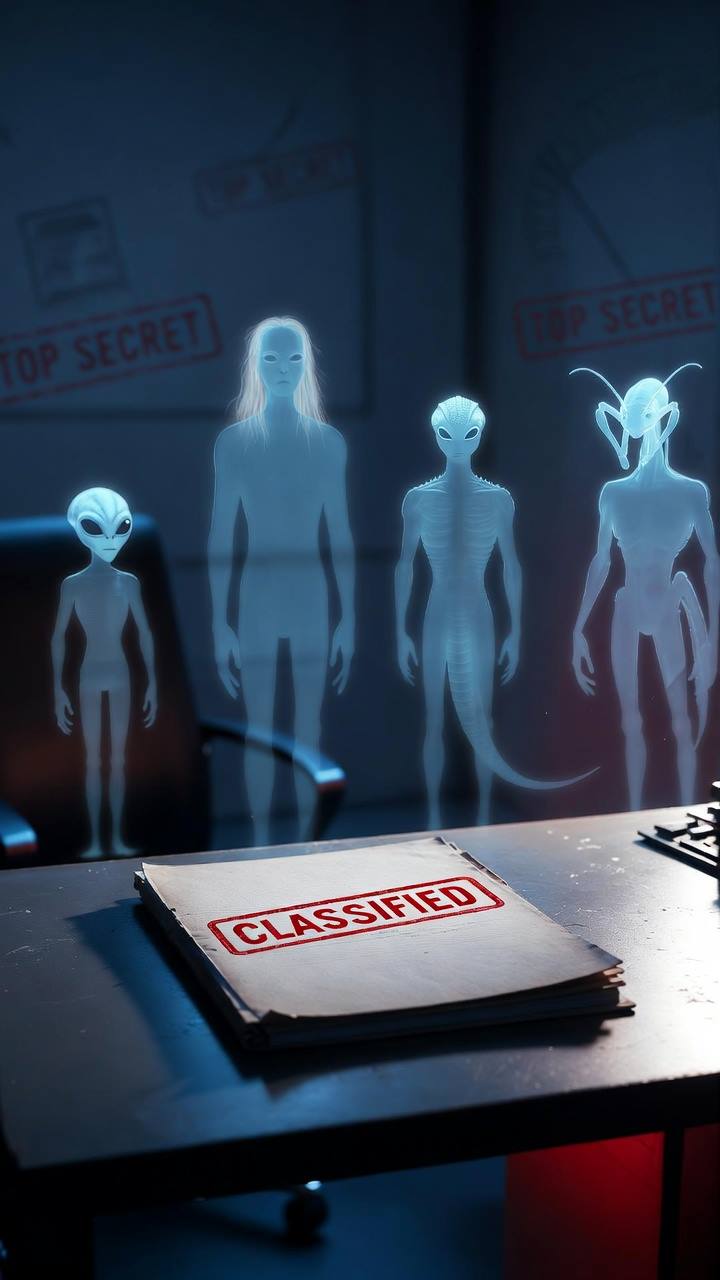
In May 2026, as agencies began posting declassified UAP material on the war.gov/ufo portal, Puthoff appeared on the Diary of a CEO podcast. The longtime physicist and former CIA-funded researcher said people involved in recoveries had described “at least four types”—“four separate types of life.” His collaborator Eric Davis had already named a four-category taxonomy in 2025: Grays, Nordics, Reptilians, and Insectoids.
Puthoff’s résumé is why the clip traveled: he directed the CIA’s Stargate remote-viewing program, helped launch AAWSAP (the Advanced Aerospace Weapon System Applications Program), and has held high clearances for decades. Davis, also a physicist tied to that program circle, has spoken in closed settings and at the 2025 UAP Disclosure Fund meeting attended by members of Congress. Résumé weight is not the same as physical evidence. The burden remains on documentation.
The timing matters as context, not as proof. On 8 May 2026 the Department of War published its first release of files, photographs and videos under the Presidential Unsealing and Reporting System for UAP Encounters (PURSUE). Days later, reporting described an NSA release of hundreds of pages of once-classified UAP intelligence. Mid-May cable and tabloid coverage—including Jesse Watters Primetime and the New York Post—amplified the four-species claim to a wide audience.
What Puthoff said on Diary of a CEO
In the mid-May 2026 interview, when asked about crash-retrieval programs, Puthoff described conversations with people he said were directly involved in recovering non-human craft and biologics. He framed the “four separate types” line as coming from those recovery-involved sources, and said he believes them. That is testimony about testimony—not a lab report.
Why media treated the clip as high-signal
Puthoff is not a random internet commentator. Stargate, AAWSAP, closed briefings, and long IC relationships explain why skeptics and believers both reacted. Within about 48 hours the clip reached primetime cable and a New York Post headline stating that four alien species had been “pulled from crashed UFOs,” attributed to an ex-government researcher. Search interest spiked. Amplification is not verification.
The four categories Davis named
At the 2025 UAP Disclosure Fund meeting (attended by Representatives including Nancy Mace, Anna Paulina Luna, and Eric Burlison, according to reporting on that event), Davis supplied this taxonomy:
- Grays — roughly 1.2 m / 4 ft, hairless, large black eyes; Davis has linked some descriptions to Roswell-era accounts.
- Nordics — roughly human-sized (~1.8 m / 6 ft), fair-skinned, light hair; often compared to northern European appearance.
- Reptilians — roughly human-sized, scaly skin, lizard-like facial features, long tails, bipedal.
- Insectoids / Mantids — tall, exoskeleton-like look, large compound eyes, elongated limbs.
All four are described as humanoid (two arms, two legs, bilateral symmetry). Davis cited intelligence reports rather than personal observation. The labels are familiar in ufology; what is newer is attaching them to recovered biologics from crash-retrieval programs as a public taxonomy. David Grusch’s 2023 testimony spoke of “non-human biologics” without this species list.
Historical and program context (claim vs paper)
Roswell 1947. The Air Force’s public explanation centers on Project Mogul. Insider accounts and some era documents have long referenced bodies. Davis’s Gray linkage is an assertion about that contested history—not a newly released chain-of-custody file.
AAWSAP / AATIP-era work. From 2008–2012, AAWSAP (via Bigelow Aerospace Advanced Space Studies under a DIA contract pathway) studied UAP-related propulsion, materials, and biological effects themes. Puthoff and Davis were central figures in that circle. Program paperwork and later testimony confirm anomalous-materials interest; they do not, in the open May 2026 dumps, publish a multi-species biologics inventory.
Grusch 2023. Under oath before Congress, Grusch said the U.S. possesses non-human biologics from crash retrievals, citing firsthand sources he did not publicly name in open session. Puthoff’s and Davis’s 2025–2026 statements can be read as an elaboration of that claim family. Elaboration is still not a released specimen.
What May 2026 releases show—and the gap
As of the mid-May 2026 reporting window around this article’s original publication, the war.gov/ufo first tranche focused on radar tracks, pilot reports, photos, and videos. Those materials emphasize unexplained flight characteristics and unresolved cases. They do not, in the released set described then, explicitly document recovered biologics or named alien species.
NSA FOIA material publicized around the same period similarly underscored long-running monitoring interest (including historical high-altitude and radar anomalies). Again: serious collection history is not the same as a published recovery catalog.
That gap is the story’s center:
- Claimed: multiple cleared voices describing non-human biologics and, in Davis’s case, a four-type taxonomy.
- Released so far (public portals / FOIA packages cited above): sensor data and sighting files, not a biologics chain of custody.
- Possible readings: (a) biologics remain more highly classified than sensor cases, or (b) the biologics claims rest on a narrower knowledge circle than the broader UAP paperwork trail. The open record does not yet decide between those readings.
Claim check: strengths and limits
What supports taking the claims seriously as testimony
- Convergence among Grusch, Puthoff, and Davis on “non-human biologics” language.
- Long clearances and AAWSAP-era involvement for Puthoff and Davis.
- Congressional attention and closed briefings in the same political cycle as expanded UAP provisions and the 2026 disclosure directive.
What undercuts treating them as proven fact
- Evidence in public remains second- or third-hand relative to the alleged recovery sites.
- No released chain-of-custody packages, DNA analyses, or peer-reviewed biologics papers accompany the podcast and meeting claims.
- AARO historical reporting in 2024–2025 stated it had not found evidence of extraterrestrial technology or biologics in the cases it reviewed—an official counterweight that belongs on the same page as the insider claims.
Puthoff and others have also described sources who decline on-camera interviews over safety or family concerns. Fear of reprisal can explain silence; it cannot substitute for documents.
If the multi-species claim were later documented
A confirmed multi-intelligence picture would complicate single-agenda assumptions, intensify great-power reverse-engineering competition (a warning Puthoff and others have repeated), and raise societal shock risks. Those are conditional implications. They are not a reason to skip the document standard.
Process asks that remain on-brand: structured release of crash-retrieval-related materials with honest redactions labels; independent scientific access under clear rules; international coordination so unilateral advantage does not drive the only incentives. Those are policy preferences tied to transparency—not proof of the taxonomy.
Primary-source anchors
- Department of War / war.gov/ufo — PURSUE first tranche (8 May 2026).
- New York Post (16 May 2026) — amplification of the four-species claim (secondary coverage of Puthoff/Davis statements).
- David Grusch congressional testimony (26 July 2023) — House Oversight public record on non-human biologics claims.
- AARO historical reports (2024–2025) — official finding of no verified ET technology/biologics in reviewed cases.
FAQ
What did Hal Puthoff claim?
On Diary of a CEO in May 2026, he said people involved in recoveries described at least four separate types of non-human life, and that he believes those sources.
Which four categories did Eric Davis name?
Grays, Nordics, Reptilians, and Insectoids/Mantids—described as humanoid forms—attributed to intelligence reporting rather than Davis’s personal observation.
Have declassified May 2026 files confirmed recovered alien bodies?
No. The war.gov/ufo materials and related FOIA packages highlighted in mid-May 2026 reporting focus on sensors and sightings. Biologics claims remain testimony-based in the open record.
How does this relate to David Grusch’s 2023 testimony?
Grusch testified that the U.S. possesses non-human biologics from crash retrievals. Puthoff and Davis add detail and a taxonomy; they do not replace the need for primary documentation.
Bottom line
Puthoff and Davis have placed a specific multi-species recovery claim on the public record. That claim sits beside Grusch’s 2023 testimony and beside a disclosure wave that, so far, has emphasized sensor files over biologics paperwork.
Until chain-of-custody documents or equivalent primary releases appear, the honest status line is: high-profile insider claims; incomplete public corroboration; active official disagreement from AARO’s historical reviews. The conversation has moved from “are UAPs reported?” to “what recovery claims can the files support?”—and the files have not yet closed that second question.
Related reading: May 2026 Pentagon UAP file explainers; Immaculate Constellation claim-status coverage; FOIA templates on Insider Release.
Insider Release — Declassified. Analyzed. Explained.