
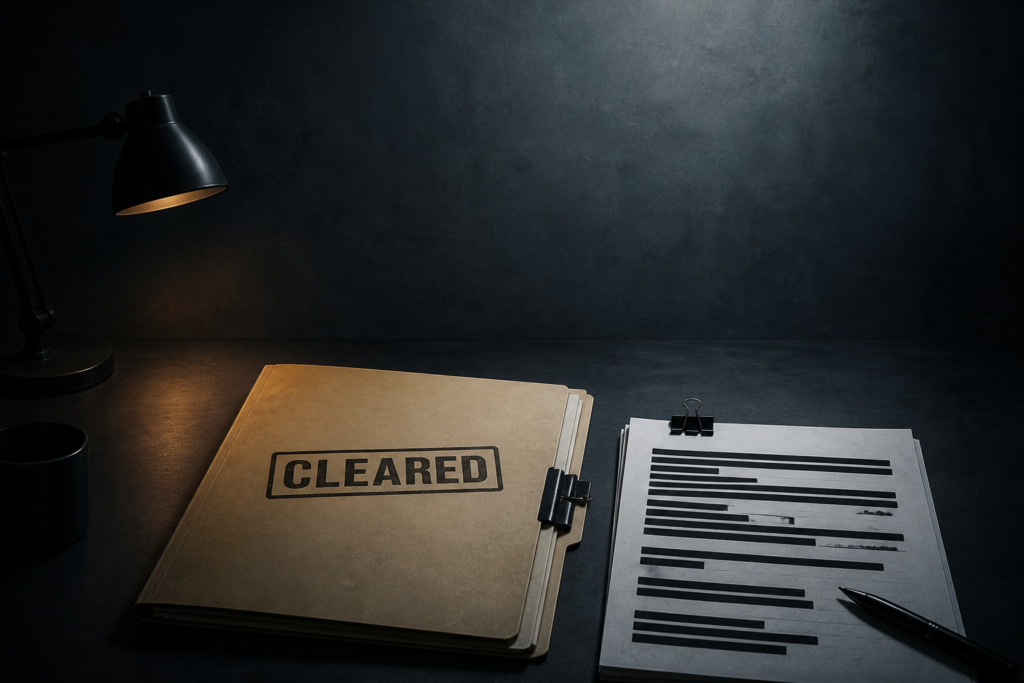
A DOPSR approval letter means less than most UAP headlines imply. Open Luis Elizondo’s Imminent and the front matter already draws the line: the views are the author’s; they do not necessarily reflect DoD or U.S. government policy; and public release clearance does not imply Department of Defense endorsement or factual accuracy. That wording is not marketing. It is the standard security-review caveat.
A FOIA trail makes the same formula clearer. In November 2020, DOPSR cleared Elizondo’s submitted screenplay Alone under case 20-SB-0149. The final letter said the screenplay was “CLEARED for public release.” It barred unreviewed photos, pictures, exhibits, captions, and other supplemental material. It also said clearance does not imply DoD endorsement or factual accuracy. That is the real letter grammar: permission to publish text reviewers judged free of protected information—not a Pentagon confirmation of aliens.
Jay Stratton’s memoir sits on the same legal track. HarperCollins imprint William Morrow lists Out of the Shadows: Revealing the Truth About Non-Human Intelligent Life for on-sale on 13 October 2026. Publisher copy is loud. A DOPSR stamp, if and when one appears, will still be quiet. Cleared for publication is not the same as verified non-human intelligence. Readers who keep those layers apart will read Stratton, Elizondo, and the Grusch NDA story with the same discipline.
In this article
What DOPSR actually is
DOPSR is the Defense Office of Prepublication and Security Review. It sits inside Washington Headquarters Services under the Office of the Secretary of Defense. Its job is security and policy review of information proposed for public release. Authority rests mainly on DoD Instruction 5230.09 and DoD Instruction 5230.29. Those instructions cover official DoD products and materials from cleared or formerly cleared people who still owe nondisclosure duties.
Manuscripts, articles, theses, briefings, and conference papers go through the process, as do some congressional products and budget exhibits. Former DoD members writing outside official duties may submit with a cover letter or email. Current employees often use DD Form 1910 through a leadership chain. Book-length reviews can take months. DOPSR’s own public guidance has warned authors not to lock publisher deadlines before review finishes.
The review looks for classified information, controlled unclassified information, and operational security problems. A policy check covers statements about DoD policy. Equity holders across components may get a vote. The outcome is a clearance stamp, a demand for redactions, or a refusal until text changes. The office does not act as a fact-checker for every claim in a memoir.
What approval allows—and what it forbids
Approval allows the reviewed manuscript to appear in public without that specific security objection. Authors may publish the cleared text. Publishers may sell it. Interviews that stay inside cleared bounds are safer. Redacted passages stay redacted unless a later review opens them.
Approval does not declassify a broader archive. It does not authorize release of DoD-owned media that never entered the review package. Black Vault FOIA records on the 2017 UAP videos show that point in practice: DOPSR clearance on a form is not, by itself, a license for anyone to publish DoD property. Public Affairs and originating components still matter for government-owned files.
Approval also does not endorse the author’s conclusions. The standard letter says so. Imminent’s front matter says so. Supplemental images and captions need their own clearance. New chapters need a new look. A podcast that goes past the book can create fresh risk.
An NDA waiver for authorised AARO talks—as in the July 2026 ODNI memo—is a different legal tool. DOPSR is about publication review. The waiver is about authorised intake. Do not collapse them.
Elizondo’s Imminent as a worked example
Imminent: Inside the Pentagon’s Hunt for UFOs reached shelves in August 2024 through HarperCollins. Coverage described a yearlong Pentagon security review. Mainstream coverage, including the New York Times package, stressed the same limit: Pentagon clearance does not imply endorsement.
Elizondo has said he still held high clearances that blocked some sourcing detail, and that approval sometimes rested on attributing material to other already-cleared public sources. Treat those statements as the author’s account of process—not a DoD affidavit that every narrative claim is true.
DoD spokespeople have told reporters a separate point: AARO has not verified crash-retrieval or reverse-engineering programmes of the kind some memoirs describe. That conflict belongs on the record. A clearance stamp does not erase it.
Where Imminent shows black bars or omitted detail, treat the gap as a process artifact. Redaction means reviewers kept protected information out. It does not mean the missing line would have proved non-human craft. It also does not mean the surrounding sentence is government-certified. Cleared text can still be wrong, incomplete, or contested.
Stratton’s Out of the Shadows — date, imprint, claim package
William Morrow lists Stratton’s memoir for 13 October 2026. Trade coverage in June 2026 confirmed the on-sale date and preorder window. Publisher and press copy frame Stratton as a former senior intelligence official central to modern U.S. UAP investigation. That is marketing language. Keep it labelled as such until the book’s footnotes and primary documents catch up.
Public-record roles still matter. Stratton’s strongest institutional anchor is the Unidentified Aerial Phenomena Task Force. DoD publicly stood up the UAPTF in 2020. Multiple mainstream profiles and later institutional summaries identify Stratton as that task force’s director. The UAPTF’s June 2021 ODNI preliminary assessment is a real government product. Cite that chain with care: it is bureaucracy and reporting process, not automatic proof of non-human intelligence.
Earlier programme names need more caution. AARO’s historical reporting describes DIA’s AAWSAP as a funded 2009-era effort under a private-sector contract after Senate appropriations. AARO has also stated that AAWSAP and AATIP names were sometimes used interchangeably in documents, and that AATIP was not a formal DoD programme after AAWSAP ended. Later informal use of the AATIP label inside DoD is a separate claim layer.
Stratton’s publisher bio says he helped create AAWSAP while serving as DIA Chief of Air and Space Warfare. Treat that as author and publisher assertion supported by secondary profiles. Prefer AARO and DIA paper for programme existence. Prefer UAPTF records for Stratton’s clearest public title.
What to watch in excerpts before 13 October
- A published DOPSR stamp or front-matter clearance note.
- The endorsement-and-accuracy disclaimer.
- Whether redactions appear as black bars, paraphrases, or silent cuts.
- Whether excerpts stay inside programme process or leap to crash-retrieval certainty.
- How AAWSAP, AATIP, and UAPTF are sourced—named hearing transcripts and ODNI products beat unnamed “programmes.”
Separate marketing from the manuscript. HarperCollins copy already promises an 80-year cover-up of non-human intelligent life. That sentence sells books. It does not equal a cleared finding. The same rule applied to Elizondo. Farah Films and William Morrow also tied Stratton’s project to the commercial ecosystem that backed Imminent. Commerce is allowed. Commerce is not clearance.
Legal-limit language in interviews matters too. Phrases like “what I can say” signal residual nondisclosure duty. They prove a review boundary, not a hidden warehouse. Pair every strong claim with a document ask: case number, stamp page, and whether photos were separately cleared.
Black Vault and other FOIA DOPSR trails
The Black Vault’s FOIA case 22-F-1178 is the cleanest public Elizondo DOPSR packet for letter wording. It returned correspondence on the Alone screenplay, case 20-SB-0149. The 30 November 2020 final letter carries the classic dual caveat: no unreviewed supplements; no implied endorsement or factual accuracy. A later Black Vault request sought the fuller 20-SB-0149 file. Track that docket rather than invent missing pages.
Other releases show the same office language on different manuscripts and interview packets. Stamps reading “CLEARED For Open Publication” appear across packages, as do notes that approval excludes photos and exhibits not specifically approved. Those trails train the eye. They do not substitute for Stratton’s still-unpublished clearance file. If Stratton’s letter surfaces through FOIA or front matter, read it against this template. Do not invent its text early.
Marketing language vs what the letter establishes
Jacket copy says bombshell, truth about non-human life, gatekeepers and cover-ups. A DOPSR letter establishes something colder: reviewers did not find protected information that blocked the submitted text—or they forced cuts until that standard was met. The letter establishes publishability under security rules. Ontology is not decided there.
AARO’s contested historical conclusions stay contested. Espionage Act risk for off-book podcasts is not waived by a book stamp either.
The Grusch NDA thread belongs beside this point. An NDA waiver for authorised AARO or PURSUE talks changes intake rules. DOPSR changes publication rules. Congress can still demand documents. FOIA can still hit Glomar walls. Clearance restoration is a personnel act. Classification is a property of information. Memoirs sit at the intersection. They are not a master key.
Treat Stratton’s October release as a process test: Can excerpts show programme paperwork? Can claims map to hearing records and ODNI products? Does the clearance note stay honest about its limits? Those questions keep UAP Disclosure coverage on documents. Lore does not.
Document anchors
For privately written works, DTM-24-005 distinguishes public-release clearance, binding amendments and optional recommendations, and separates the author’s views from official policy.
- DoDI 5230.09 and DoDI 5230.29 — DOPSR review authority.
- Imminent front matter — no-endorsement / no-accuracy caveat in public print.
- Black Vault FOIA 22-F-1178 / DOPSR case 20-SB-0149 (Alone) — formal “CLEARED for public release” letter language.
- William Morrow listing — Stratton Out of the Shadows, on-sale 13 October 2026.
- UAPTF / June 2021 ODNI preliminary assessment — Stratton’s sturdiest public institutional hook.
- AARO historical reporting — AAWSAP/AATIP naming caution.
Keep three piles separate: (1) official instructions and stamped letters; (2) author memoirs and publisher jackets; (3) oversight memos, hearing transcripts, and AARO reports. Viral posts mash the piles together. Document-first readers keep them apart.
FAQ
What does a DOPSR approval letter actually mean?
Reviewers cleared the submitted text for public release under DoD security and policy rules. The stamp does not endorse the claims or certify them as factually accurate.
Did DOPSR clearance of Imminent confirm Elizondo’s UAP conclusions?
No. The book’s own front matter says public release clearance does not imply DoD endorsement or factual accuracy. Clearance is about protected information, not validation of non-human intelligence claims.
When does Jay Stratton’s Out of the Shadows go on sale?
HarperCollins lists the William Morrow hardcover for on-sale on 13 October 2026. Until then, treat jacket copy and interviews as claim packages awaiting the manuscript and any published clearance note.
Is a Stratton DOPSR letter already public?
As of this article’s 5 September 2026 baseline, researchers should not invent Stratton DOPSR letter text. Watch for front-matter disclaimers and later FOIA releases. Use Elizondo’s public letter language as the template, not as Stratton’s file.
Does clearance let an author release any DoD video or photo?
No. Standard letters exclude unreviewed supplements. FOIA records also show that DOPSR clearance is not automatic permission to release DoD-owned media. Ownership and Public Affairs rules still apply.
Bottom line
A DOPSR approval letter clears text for publication. It does not certify aliens, crash retrievals, or reverse engineering. Imminent already prints the no-endorsement and no-accuracy guarantee. The FOIA-released Alone letter shows the same grammar. Stratton’s October 2026 memoir will face the same limit even if marketing does not. Watch excerpts for stamps, redactions, and sourced programme history. Keep NDA waivers, clearances, and classification in separate lanes. Process coverage beats lore.
If you hold a primary scan of a Stratton DOPSR letter or stamp page—or new Elizondo clearance correspondence beyond the published Alone packet—post an archive link. Prefer PDFs with case numbers over screenshots, and front-matter photos that show the disclaimer in context. Speculation without a document does not help the record.
Insider Release — Declassified. Analyzed. Explained.
For the DIA contract that later got conflated with AATIP branding, see AAWSAP.